Until now, I've read many self-development books and books about business techniques, and every book explains “how to work efficiently” and “how to make effective use of time,” and I think I've learned it by processing it in my own way. However, as it is written in this book, I think that the more efficiently I get the job done, the more work I have, and I reached retirement last year with that feeling.
This book has features not found in business books up until now: 1) while making an effort to be efficient, 2) there is no need to set goals or what you want to do first, and 3) there are things that are more important than money. Even though I've finished working for a company, I intend to continue getting involved with society, so I wanted to incorporate what is written in this book in my own way.
Below are the points I was concerned about.
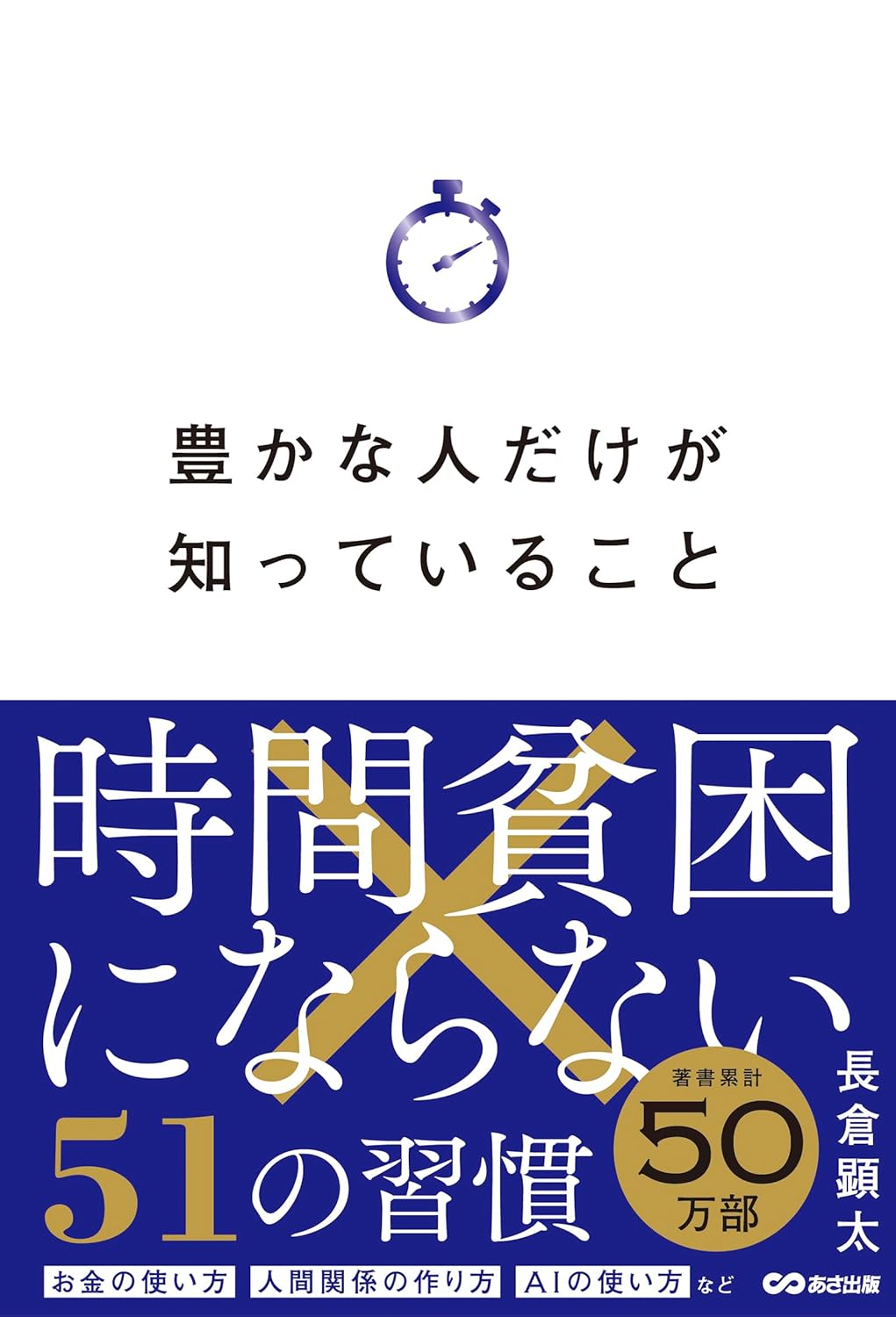
・I don't have time to do what I want to do, I don't have time to think slowly, I don't have time to try new things, I don't have time to spend time with my loved ones, I don't have time to live my own life, this is “time poverty,” time is the most valuable asset in life (p6)
・I may have felt motivated right after reading the Jutsu of Time books that are all over the street, but there are many cases where I returned to my original life less than a week later. The reason for this is that all time jutsu up until now have pursued only “efficiency,” so even if they succeed economically, they become poor in terms of time, and conventional time jutsu have created “time poverty” (p7)
・ “Super efficiency time” and “inefficiency time” should be separated, productivity is thoroughly increased in super efficiency time, and time is shortened by working 10 times faster using AI, etc. The time created as a result is turned into “inefficient time,” that is, “super efficiency time” time to create “inefficient time” (p9)
・A rich life is often the sum of the “4 assets,” and the 4 assets are time, ability, relationships, and money. Of these four, the only thing given equally is “time” (p10)
・Life is controlled by chance, but whether or not it is going in a good direction is greatly influenced by the factor of whether or not you know the “rules of life,” and a good life depends on whether “convenient coincidences” occur for you. There is a high probability that a convenient coincidence will happen in a good place, so it is important to increase the probability that even a small good coincidence will occur by knowing the rules of life (p32)
・Despite setting things like “life goals,” many people don't know where to start, it is necessary to know how much “time, abilities, and relationships (assets that can be obtained after achievements come out) and money” they have, how much of these 4 things they have, and how to increase them is the basis of life strategy (p35) What we should think about is “where is the asset called time It's “how to invest” and “where to invest to expect the greatest return” (p37)
・Human relationships do not create relationships; what is formed before you know it is human relationships; they expand through “introduction” rather than meeting people; the order of “time” → “ability” → “relationships” → “money” is important, and increasing assets in this order is a “rule of life” (p39)
・The author usually sends out “you don't need to do what you want to do,” but that doesn't mean you don't need anything at all; if you don't have some kind of purpose, you can't establish a strategy, but there's no need to force yourself to search for “what you want to do” (p40)
・The only thing we can control is “now,” first think about how to use the day, think 1 week, 1 month, or 1 year as an extension, and the result becomes life (p45)
・The present is the “result” of what has been done in the past, and if you change how you use your current time, your life will be the way you want to to some extent. If you change the present, the future will change, and since you can control the present, you can control the future too (p47)
・We unknowingly make many choices that lead to the “past,” so many people's lives don't change. In order to overcome that, if you get lost, choose something unknown (p61)
・In the end, only those that continue will produce results, and the “can we continue” part is important even when thinking about how to use time (p68)
・This is because being different from others becomes a survival strategy, and “non-public time” is necessary for that, and by challenging the unknown more and more, they become creative and unique people (p71)
・ The purpose of “super efficiency time” is to generate more “inefficiency time”, to shorten super efficiency time and create as many “inefficient hours” as possible; specifically, if you can finish what you have been doing in 8 hours until now in 2 hours, you will be able to have 6 hours of inefficiency time (p74)
・The three assets other than money change whether cost performance is good or bad depending on the person's values, so it is necessary to clarify one's own values. In the case of abilities, whether you have acquired some kind of skill, time shared with people who have learned improves ability, new experiences contribute to abilities because they raise experience points, and in the case of human relationships, it is limited to encounters with people who have knowledge or experiences you don't know and that lead to learning. All actions to become someone who is introduced to such people also lead to relationships (p81)
・ AI is the strongest time-saving tool anyone can use, so buying time is the best investment. And AI is the most efficient way to change time. Thoroughly leave what can be left to AI, and humans spend their time doing things only humans can do (p89)
・When getting the latest AI information, you can get the latest AI information with the prompt “Tell me 5 important news and update information about AI from last week to this week, and explain how each can be used in my work” (p97)
・No matter how much productivity you increase, your life will not change; your life as an extension of the past will only accelerate. Therefore, it is very important how much time you do nothing called “inefficiency time” (p108)
・What I really want to do is “something I want to do even if I don't have to do anything.” What you want to do is only born when you have enough money and don't have trouble living for the rest of your life, and you don't have to do anything (p116)
・Gives minus takes are “chance,” and this is the law of chance, an opportunity comes when you give more than a take (p125)
・If you maximize the asset called human relationships, you can cover the other 3 assets; if you have relationships, you can get time if you ask someone who has time, money if you team up with people called money, and abilities if you team up with people with abilities (p130)
・What is important in human relationships is trust, and people who are trusted are people who are punctual and can be cared about (p131)
・By changing from the person being introduced to the person being introduced, the number of people introduced will increase further. Become the person being introduced, and relationships expand steadily, and assets such as time, money, and ability automatically increase (p146)
・My basic strategy is to “team up with excellent people,” because it can be said that success is promised at that moment, and after that, I concentrate on preparing an environment so that that person can work comfortably. After all, relationships are the strongest “time-saving” (p147)
・There are two reasons why it's better not to have anything you want to do: 1) From now on, you will experience multiple occupations in your life. The occupations needed are being replaced more and more in the midst of the rapid changes of the times, so you are forced to work for a number of occupations throughout your life; 2) existing occupations disappear and new occupations are born, making it difficult to establish the occupation you want to become (p154) Those who don't have anything they want to do can respond flexibly to the times (p156)
・What is important in life is “act and then think” (p165)
・The accumulation of small routines drastically changes your life, and what is recommended as a routine is “reading,” and the more you keep reading, the more effective it becomes. There is no major change just by reading 1 book, but if you read 100 books, the way you see the world (p169) The trick to making a routine is “start small and keep going” (p170) If you continue for 90 days, it becomes a habit, and if you continue for 180 days, you feel sick if you don't do it, so concentrate on continuing anyway for the first 90 days (p171)
・The fun of traveling is not only on the day, but also at the planned time. If you decide not only your next trip but also “what's next,” continuous enjoyment will be created in everyday life. Having plans for the future makes every day shine positively, and planning is the best motivational device (p198)