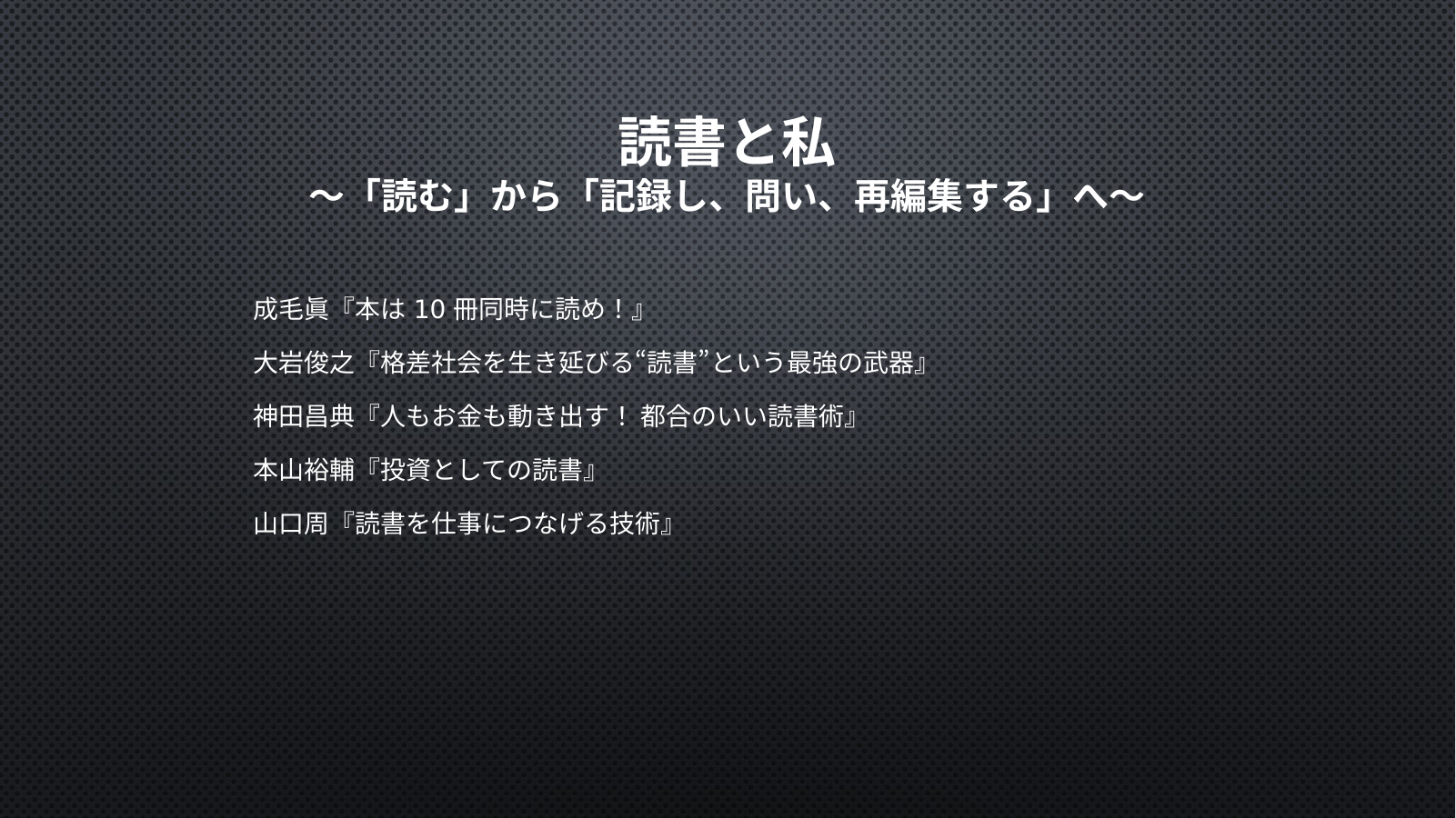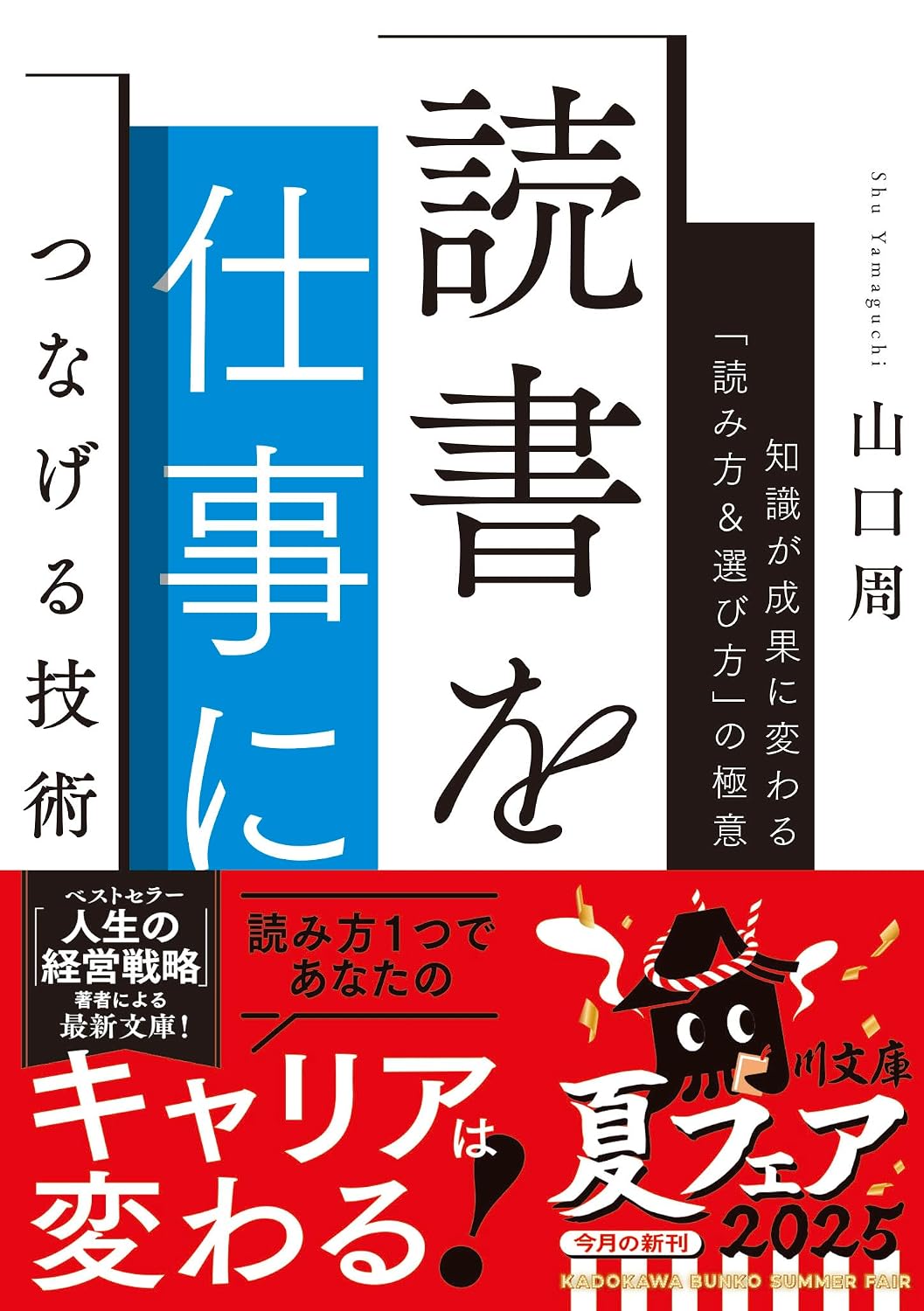
Mr. Shu Yamaguchi states that learning through reading was behind his continuous work in the consulting industry for over 10 years, despite having walked through a career that was far from business himself (p9). However, what this book emphasizes is not simply “reading a lot of books.” Rather, what is important in order to apply the knowledge and sensitivities gained through reading to work is “after reading” **. It is said that people who read a lot but are not connected to work have problems with how to organize and store purchased information and the ability to combine information according to the context of work, rather than the amount of “purchases” (p11).
The author assumes that in order for business people to continuously raise high intellectual productivity, two types of reading are necessary. One is to read famous business books carefully, and this is reading that creates “basic physical strength” as a business person. Another is reading books about liberal arts such as history, philosophy, literature, etc., that is, education, etc., and this is reading to form the “personality” of that person (p22).
While famous business books lack a foundation in work if you don't know them, it is difficult to differentiate yourself from others just by knowing them. The author likens this to “prescribed performance.” On the other hand, education is “free acting,” and I think that “intellectual fruit typical of that person” will be born for the first time by combining knowledge obtained from education with business knowledge (p23).
Therefore, the reading method is different between the two types of books. Business books are read over and over again, and basically read “narrowly and deeply” without taking reading notes. Meanwhile, liberal arts books cover a wide range of miscellaneous fields, read “broadly and shallowly” as interest goes, and leave records after reading (p24). There are many cases where information obtained from education books cannot be understood what it will be useful for in the future at the time of reading it. Therefore, it is important to create a reading notebook so that it can be reconsidered and referred to later (p25).
Also, the author assumes that it is not necessary to read every book from beginning to end. They say “only 20% of books should be read,” and the table of contents is used as a way to discern that important 20%. Look at the table of contents, and if there is a chapter summarizing the whole summary, conclusions, etc., first determine the important parts of that book by reading from there (p27). On the other hand, there are a lot of books to read, and it is recommended to read 10 or more books at the same time. Ten books is the minimum, and the idea is to reduce the amount of time spent doing nothing in life as much as possible by keeping multiple books close to you (p43-44).
As for business books, they are careful about following new issues one after another. Most of the content written in new business books simply explains what is written in classic masterpieces by changing cases and industries. Therefore, in business books, it is more important to read basic masterpieces repeatedly rather than reading a large number of new publications (p59). Also, knowledge obtained from business books can be applied relatively quickly to work, and since the messages of good books are simple and clear, they are easy to keep in memory. On the other hand, since it is not known when knowledge from education books will be useful, a mechanism that can be retrieved later is necessary (p65).
And the key idea in this book is “abstraction” ** for transforming knowledge into a form that can be used for work. Abstraction is to discard the detailed elements of individual cases and extract the essential mechanism of “what is it in short.” The author explains it as something close to “modeling” in economics. By extracting the basic mechanism behind it instead of memorizing specific cases as they are, knowledge can also be transferred to different situations (p133).
Furthermore, the author assumes that people will forget the content even if they read the book. What is important is not to improve memory, but to create a “mechanism that can be forgotten.” The method is to “transcribe” parts that were thought to be important after reading the book as digital data and leave them in a state where they can be retrieved and referenced at any time (p141). The author explains that instead of storing important information in the head, it is more reasonable to let it swim alive in an “IKES” that can be accessed at any time, take it out when necessary, and “cook” it by combining it with other information.
However, not everything should be transcribed. The author himself has set an upper limit of 9 places to transcribe per book. If the number is limited, it is necessary to determine what is really important, and the sorting process itself leads to deep reading (p150).
The reading method shown in this book is not simply gathering information. **Build a foundation with business books, expand individuality with education books, store important information in a searchable form, abstract it, and combine it with other knowledge in situations where necessary. **Rather than storing large amounts of information in the head, having a mechanism for appropriately stocking information, retrieving it when necessary, and reconstructing it is the core of transforming reading into intellectual results at work (p36, p133, p141).