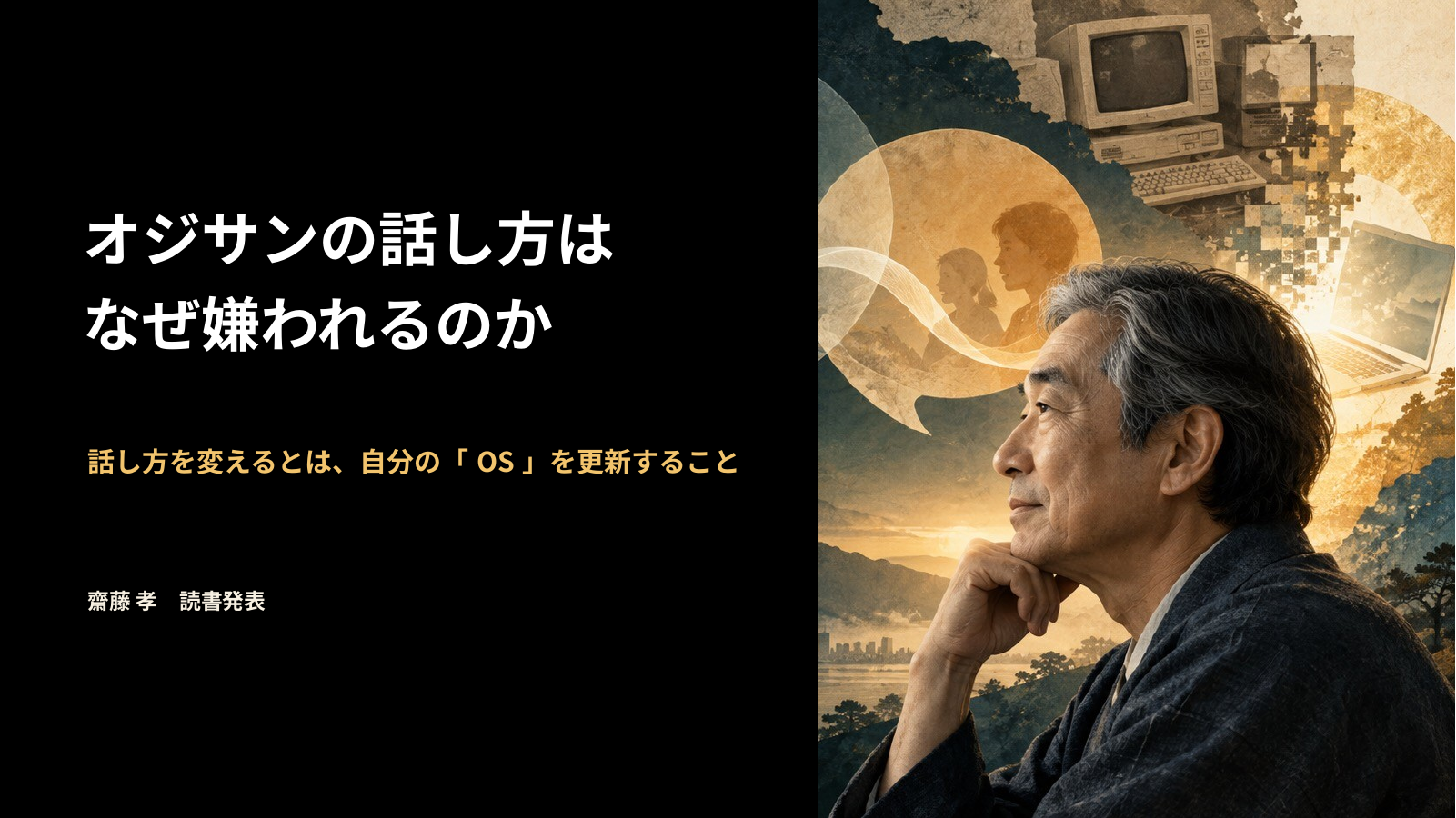
In this book, Saito Takashi asks that the biggest reason why “the old man's way of speaking” is not age itself, but that the way he speaks has not been updated according to the times. In sports, when the rules change, players and coaches also change their strategies. Similarly, communication also has rules for each era, and they change in a shorter cycle than sports. However, among people who have aged, there are people who rely on past common sense and successful experiences and continue to talk with the feeling that “this worked in the past.” The younger generation doesn't necessarily point it out, and there are times when they take a distance without saying anything and suddenly break off relationships one day. Therefore, what is necessary is not to wait to be warned by the other party, but an attitude of updating the way of speaking from oneself (p3 to 6).
The “old man” referred to here is not fixed by age. No matter how old you are, you can become an “old man” when viewed from a generation below yourself (p18). In particular, the author states that if you continue the “3 no stance” of “not knowing, not aware, or don't care” about harassment, gender, etc., it is inevitable that you will be shunned by the younger generation (p30). What is important is not only to superficially correct actions, but to renew the very foundation of the way of thinking. Mr. Saito likens this to a personal computer that doesn't work well even if a new application is installed with the old OS (p31).
To that end, it is important to honestly say “I don't know” and “I don't know” without pretending to have forcibly known something you don't understand (p37). Also, it is necessary to have an interest in the “now” rather than limiting one's interest to the things one likes in the past. People of different generations and occupations recommend books, movies, music, etc., and replace about 20% of my staples with new ones. It is recommended to improve sensory ventilation by consciously incorporating the unknown without solidifying everything according to one's own preferences (p41 to 42).
Furthermore, Mr. Saito explains that it is necessary to change the role itself of people as they age. Instead of competing on the same playing field as young people, they make use of the experience and knowledge they have accumulated until then and turn to the side that supports young people (p45). Moreover, past success was influenced not only by one's abilities, but also by external conditions such as timing and historical background. Never look at successful experiences (p56). It is said that even when bragging, it is necessary to have enough restraint to keep it within 5 seconds (p59).
In relationships with the younger generation, it is important to keep a flat perspective and face each other on an equal footing without assuming a hierarchical relationship (p63). Rather, when the elders show an “attitude of being taught,” the younger generation also feels “I want you to teach me this too.” The elders provide experience and knowledge, and the younger generation provides new sensitivities and information. This “exchange” deepens mutual understanding and enriches relationships (p65). The author also touches on Socrates and states that the starting point of knowledge is to notice “I didn't understand” while discussing with young people on an equal footing without assuming that he understood (p67).
Even when there is a conflict of opinion, it is important to first confirm why the other party wants to do so and what circumstances exist, and then calmly explain why they are unable to respond (p80). Even when confronted with a rule violation or mistake, they do not immediately respond with “success or failure,” they stop once, put a brake on their emotions, and choose words (p86). Also, when I make a mistake, I honestly admit “it was a mistake.” Rather than making a mistake itself, how you behave after making a mistake affects whether you are disliked (p98). An attitude of not deciding on one's own thoughts, presenting them as a hypothesis that “may be ○○,” and confirming whether there is any refutation in conversation is desirable (p103).
In conversation, “listening” is more important than speaking. Mr. Saito cites the compatibility of “ha-fu-he-ho” as an example, and recommends accepting the story of the younger generation based on responses such as “Wow, I didn't know, tell me more” (p117). Conversely, what is easily disliked is a “conversation thief.” While the other person is talking, they replace “in my case” with my own story. Even if I have had a similar experience, I first listen to the other person's story until the end, and then cut out “Actually, me too.” It is said that “latecomer junken conversation” is basic (p121-123).
Also, the way old men speak from the younger generation has characteristics such as “talking for a long time,” “repeating the same story,” “difficult to understand,” and “fearful of facial expressions and attitudes” (p142). The author is aware of the talk time limit of about 15 seconds, and recommends speaking with a conclusion first. This is because if you start explaining carefully from the background and circumstances, it will take a long time to get to the main subject (p148 to 150). You also need to be careful about telling the same episode over and over again. As for endings, it is assumed that speaking can be softened by using “” (p170).
Furthermore, since jokes are established only when the speaker and listener share the “original story,” it is necessary to be aware of generation differences (p184). On the other hand, pets such as dogs and cats are more likely to be talked about across generations, and it is easy to end conversations with positive emotions (p197). Even when asking questions to young people, I listen to the “present” rather than the past. It's easier for people to talk to if you ask “what are you obsessed with now” rather than “what did you like when you were a student” (p207).
What Mr. Saito is looking for throughout this book is not compliance with young people. Instead of fixing past successful experiences and common sense with age, it is about accepting changes in the times and continuing to update one's own consciousness and way of speaking. Admit what you don't understand, treat the other person as an equal, listen first, and keep your story short. Also, the elders do not teach their experiences unilaterally, but rather exchange them with the new knowledge and senses of the younger generation. The central message of this book is that this attitude is the condition for establishing communication across generations.
summary
Why do people dislike the way old men speak