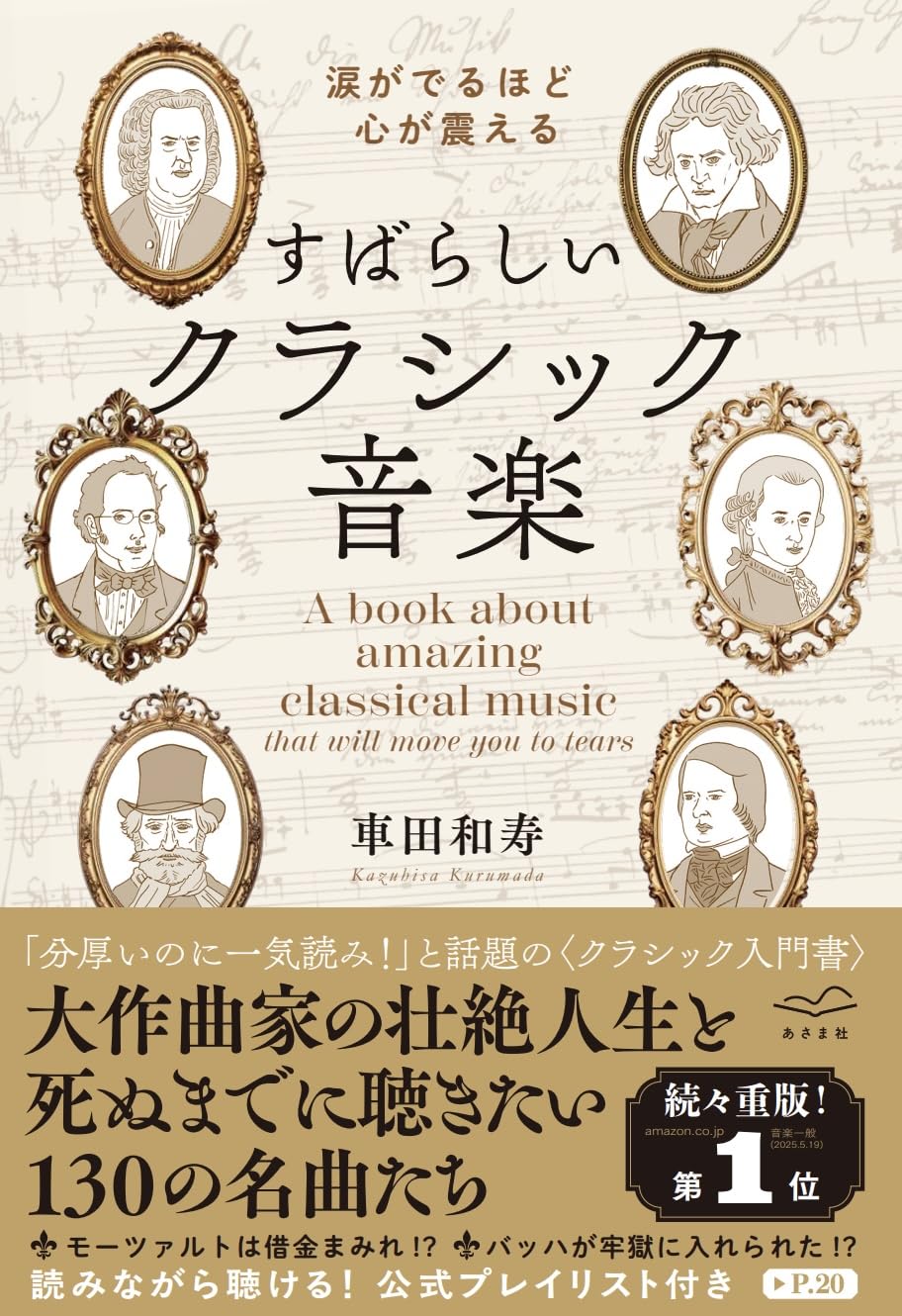
When I went to play at my uncle who lives in Osaka the other day, I was introduced to this book by my uncle who likes classical music, and I was given it as a present because I finished reading it. The author of this book, Mr. Kurumada, is active as a vocalist, and the 10 musicians he chose are introduced along with interesting episodes.
What is particularly impressive is that, along with the explanation of the work, it also introduces what kind of historical incidents occurred during the period when each musician was active, whether they met at that time, and what kind of relationships they had.
From our point of view today, the 10 people featured here are all great musicians, but in the days when they were active, they also had relationships with seniors, juniors, great musicians, and budding musicians, and that relationship, for the first time, I was able to learn about that relationship with this book, and it was very fresh information.
Below are the points I was concerned about.
・Music has many attractions and important things, and one of them is that “music is the communication of the mind.” The composer uses what he feels into sound, and what he feels is conveyed to the audience through the performer. At that time, a chemical reaction occurs there, and the listener receives many stimuli by receiving various emotions. As a result, various emotions are aroused in the listener's mind, which eventually leads to dialogue with oneself, and depending on the person, it is possible to flap their wings from there into a world of fantasy (p5) The other is that music is an entrance and tool for entering a world of free mind. Listening to music also means accepting various emotions, and the listener's state of mind changes constantly as they accept such emotions. Then, various thoughts circulate through my head, and in some cases, various stories come to mind. When we listen to music, we can flap our wings into a world of imagination and creation (p9)
・Bach is now known as a great composer, but his subjects at the time were by no means expensive compared to Handel Telemann. Even if a post somewhere went blank, Bach almost never came up as the first candidate for a successor, and Bach, who was not a college graduate, felt frustrated (p35)
・Baroque began to be used in the sense of criticizing things that have a lot of decorations and are luxurious. It was defined as music whose harmonies were chaotic, full of modulation and dissonance, and the melody was deafening, unnatural, difficult to intonation, and unnatural in movement (p59)
・Mozart was a versatile composer, and left masterpieces in almost every genre, from opera to symphonies, religious songs, piano sonatas, and string quartets. This is remarkable even if you think about it in music history; there is probably no other composer this versatile (p83)
・Mozart's Requiem consists of 14 songs, but Mozart was able to complete only the first one by himself (p96)
・The sonata format consists of 3 parts; the first part is called the presentation part, the middle part is called the development part, and the last part is called the reproduction part, etc. Two types of melodies appear in the presentation section, and they reappear in the reproduction section. This sonata form is a characteristic of the classical school in its sophisticated and beautiful form. Haydn, who created the form of symphonies and string quartets, is sometimes called the father of symphonies or tour quartets. The symphony was completed by Beethoven, who was taught by Haydn. Also, many composers, up to Schubert Schumann, Brahms, Mahler, Tchaikovsky, and Shustakovich, tried symphonies using Beethoven and others as examples (p105)
・The bronze statue of Beethoven was built in 1845 to commemorate the 75th anniversary of his birth, about 20 years after Beethoven died. He raised funds for the monument, but it was difficult, and one composer who knew about it cooperated; that is the list; he actively held many concerts to that end and donated nearly 1/4 of the construction funds, and Schumann also published “The Great Sonata,” and donated the proceeds as construction funds (p111)
・Neefe, who also worked as a court organist, gave Beethoven Bach's “Average Law Clavier” as an assignment, and appointed Beethoven, who was only 11 years old, as his assistant. Beethoven's reputation around this time was extremely high, and he was described as “there is no doubt that he will become the second Mozart” (p116)
・Beethoven, when he was 18, met Haydn, a composer representing the classical school. When Haydn stopped by Bonn during his trip to London, Beethoven studied under Haydn in Vienna (p118)
・Beethoven's music becomes more eloquent as we become deaf. Beethoven spoke eloquently what he wanted to say in his music, and various thoughts remain in Beethoven's music. When I listen to those thoughts, little by little I can see what he never showed in public (p127)
・Schubert's talent was such that he made the orchestra conductor say, “He received everything from God.” Eventually, court orchestra leader Salieri took on the direction of Schubert's composition. Salieri was a person who also taught Beethoven, but he was an enthusiastic mentor who taught without taking money from poor musicians, and the relationship between Salieri and Schubert continued even after Schubert graduated from school (p155)
・Composers who have left their mark on history are definitely great people who fall into the category of geniuses, but among them, there are 2 composers that make you feel something called “nature.” This is because it can be said that Mozart and Schubert had reached a state that people could not reach with effort. These two people have a lot to do with insight and imagination (or creativity). With their abilities, these two were able to easily see things that ordinary people cannot see so easily (p169)
・With the release of the record, various modifications were applied to create the best one, and recordings made in this way were very different from the way music was until then, where once the first sound started making a sound, it progressed unstoppably until the end. The benefits of recording are enormous, and recording has the splendor of recording, but even though it is the same music, the quality is slightly different from live performance. In a live performance, from the moment the sound starts, emotional energy flows uninterrupted towards the end. Experiencing this energy is the real thrill of live music, and the sound of actual instruments and singing voices can only be enjoyed in live music (p190)
・The period in which Schumann was active is called the Romantic Era, and signs of the Romantics were visible in the later years of Beethoven and Schubert, but it was from Schumann that the Romantic era came. Many composers were born in this era, and each left their mark on history, and Schumann Chopin Mendelssohn Liszt Wagner Verdi is 5 years old (p212)
・Schumann succeeded Schubert in German songs represented by “The Poet's Love.” Schubert beautifully expressed the world view of the poem with simple accompaniment and melody, but Schumann's songs are more eloquent, and the piano part takes on emotions that cannot be expressed in words (p219)
・String quartets with double bass were also seen before Schumann, but after Schumann, piano, two violins, viola, and cello became standard (p225)
・Romanticism is a way of thinking that emphasizes instinct over reason, imagination over form, and mind over head, which comes to be used as an opposite word to classicism and classical music. The idea is to express the instinctive demands of the heart without relying on forms such as classicism, and there is a desire to release a mind that has been suppressed by society in such a background (p227)
・Composers such as Bach and Beethoven aimed to reach certain spiritual heights using music, but what Paganini and Liszt aimed for was the pursuit of high technology to maximize the performance of the instrument in front of them, and one of the songs born as a result was “La Campanella” (p230)
・Liszt and Wagner are composers representing the Romantic School about 20 years older than Brahms. Liszt and Wagner are composers who quickly tried to break away from the form up until then, Liszt changed to symphonies to create a genre called symphonic poetry, and Wagner called opera a musical drama, and emphasized the drama of music. Brahms clearly showed opposite intentions to the two people who tried to create such a new movement, and the music Brahms aimed for was classical music like Beethoven, not romantic music like the two. Both Liszt and Wagner were outraged by this attitude when Brahms was evaluated as an excellent young musician, and the European music world later split into the Brahms School and the Wagner School (p245)
・In the history of classical music, many composers were born, but in order to be called a great composer among them, it was necessary to succeed in two genres. It's a symphony and opera. What they have in common is that the scale is large and the performance time is particularly long, and in order to compose these two, considerable skill is required as a composer. After composing a piano sonata, Beethoven applied it to a string quartet and expanded it into a symphony for orchestra. It was a symphony that was finally written after such preparations. Operas don't have many formal rules like symphonies, but they have a script and the job of connecting words and music, and their length is more than three times that of a symphony (p291)
・Since playing instruments is prohibited in Russian Orthodox music, everything is sung in a cappella chorus (p353)
・The Nutcracker is one of the representative works of Tchaikovsky Valley music, and along with Swan Lake and Sleeping Beauty, it is called one of the top three ballet songs (p357)
・Chaliapin, who had bad teeth, requested that he wanted to eat tender meat and made a steak soaked in grated onions by beating beef to soften it; this was called “Sharivian steak,” and the sauce with chopped onions came to be called Sharipian sauce (p386)
・Rachmaninoff achieved success in all three fields: pianist, conductor, and composer. His personality was a good-natured and forgiving personality in front of his family and friends, but he is known for being a very strict person who did not allow any compromises in music (p394)
・There is certainly nothing better than not making mistakes when playing music, but there are things that are far more important than that. It conveys emotion; music flows from the time the first sound is heard to the last sound without stopping. The stronger the flow of that music, the more energy and momentum it reaches the audience as a performance (p412)
・The major difference between a piano and an orchestra is whether the sound can be extended or not. In the case of a piano, once a sound is played, it disappears, but with wind instruments and stringed instruments, the sound can be extended, and various expressions can be performed, such as crescent and recrescent while stretching, or changing the way vibrato is applied (p441)
・What is music for? Music is an expression of emotion. The audience will accept that emotion, and by accepting the emotion, the audience's mind will also be forced to change in some way; what is important is what kind of world unfolds in one's mind or head after accepting it, and that is that person's free world. The audience has the freedom to listen to music and imagine stories in their minds. It is important to feel a change of mind when listening to music (p442)