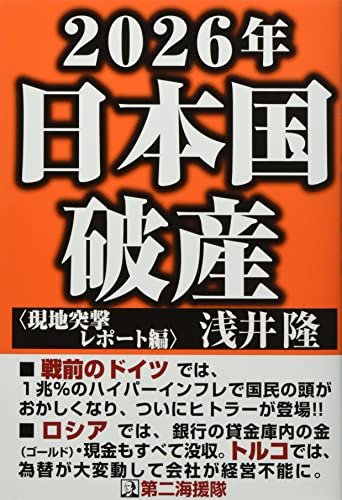
・The interest rate (repo interest rate) in the call market, where large banks and large companies around the world exchange ultra-short-term funds (dollars) for settlement on a daily basis = the heart of modern capitalism, was around 2-2.5% on one day in the fall of 2019, but it instantly became 10%. The Federal Reserve managed to hold it down by investing as much as 6 trillion yen of funds into the New York Federal Reserve, which is under its umbrella, in just one day. The cause of this is said to be quantitative easing (continued since 2008) (p18)
・In the case of Japan, interest rate increases will come by 2030, and if the government goes bankrupt, the value of yen will rapidly fall and the yen will depreciate, and the value of yen will be about half (p19)
・The total amount of economic stimulus measures introduced in the world as of early August 2020 is 20 trillion dollars = equivalent to about 20% of global GDP in 2019, and it can be said that it is an unprecedented scale (p65)
・Vaccines can be broadly divided into a “conventional type,” which uses the virus itself, and a “genetic vaccine,” which puts only part of the genetic information of the virus into the body, but what is currently being developed ahead in each country is a “genetic vaccine,” which has not been approved until now or has no track record at a practical level (p69)
・First, we should prepare for further deflation; that period will probably be around 2022-25, but now we are entering a period where we should be very wary of inflation. There are two choices: the collapse of the bond bubble or damage to the credibility of currency values (p88)
・On 2019/6/18, the government decided on an answer to the 20 million yen retirement problem by comparing the average income and expenses of households with elderly couples that are not working and that 50,000 yen is insufficient every month, 13 million yen in 20 years of starting receiving a pension, and 2000 spread shortage in 30 years (p92). On 2019/6/18, the government decided on an answer refusing to respond on the grounds that it was not received as an official report. On September 25, at the general meeting of the Financial Services Council, it was decided that the report would not be an agenda item (p95)
・Looking at households with financial assets, the average value is 15.37 million yen, the median value is 8 million yen, and since the median value is close to reality, the average image of financial assets of a general household is probably about a few million to 10 million yen (p117)
・According to the simple life table, the average life expectancy at age 65 is 19 years for men and 24 years for women (p120) 50% survival age for women born in 1955 is 95 years old for women, 88 years old for men, 25% survival rate is 100 years old for women and 94 years for men (p121)
・GHQ means imposing punishment on companies involved in the war, and payment of wartime compensation debts was not permitted, and a 100% wartime compensation special tax was applied to payment of wartime compensation debts (p150)
・The definition of hyperinflation = 50% monthly rate = 13,000% per year = prices are 130 times higher in 1 year; inflation right after the war in Japan was 70 times higher in 1945-49, which is a state of national bankruptcy. The ranking of hyperinflation is 1) Hungary double in 15.6 hours, 2) Zimbabwe 2008, double in 24.7 hours, 3) Yugoslavia 1994, double in 1.4 days, 4) Germany 1923, double in 3.7 days, 5) Greece 1944, double in 4.3 days (p169) these are fulminant types, Russia, Turkey, and Japan after the war becomes chronic (p173)
・The difference between France and Japan is that in France, the ratio of extramarital children to be born is 59.7%, and Japan is 2.3% (p199). In France, the number of children whose parents are both French has drastically decreased (p196)
・Reasons for the fall of the Roman Empire: 1) increase in spending due to military buildup to respond to the invasion of Germanic peoples, 2) crop failure = revenue reduction due to the shift in climate trends from warming to cooling, 3) currency modification (reduction in silver content) (p222) when replaced with the present, an increase in social security expenses (increase in expenditure), normalization of low growth (revenue reduction), monetary easing = reprinting of banknotes (currency reform) (p224)
・Internal debt countries (Japan) almost always launder inflation taxes first, and when the social cost of inflation becomes too large, this time they drive to debt; the first thing we should be wary of in Japan is inflation tax. Financial suppression in technical terms, the government creates a situation where investors feel they are forced to buy bonds at unfavorable interest rates, that is, interest rates below the current level of inflation, and reduces national debt; this is England where government debt wants to double GDP due to World War II, and it continued for 30 years from 1945; this was an English disease (p234)