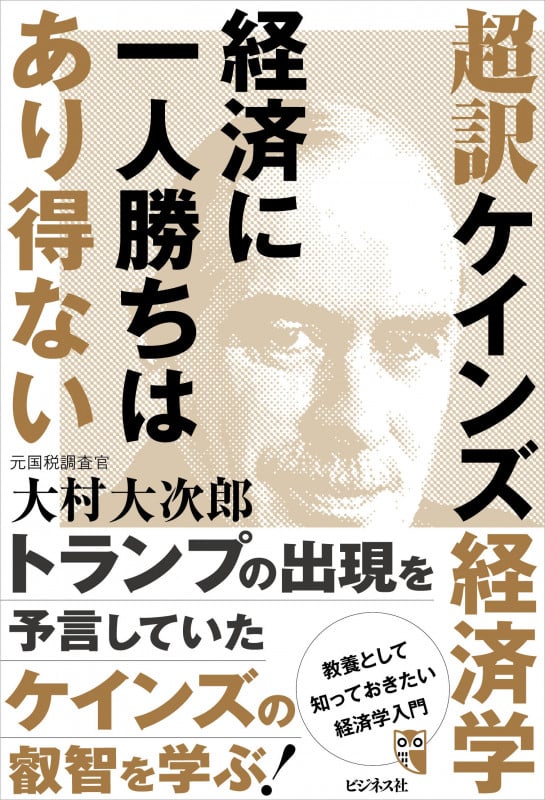
・In order to know Keynes's economic theory, it is necessary to know what kind of economic state the world was in at that time and what kind of problems it had. In the Keynes era, while the world became rich due to the industrial revolution, unemployment was largely brought up as a social issue, and imperialism centered around England flourished, and the world economy was being waged in a war of heist where the weak and the strong eat had no rules. Among them, I researched new rules and orders and disseminated them to the world about how people can live a rich and peaceful life (p5)
・The main ones in Keynes's theory are 1) if severe compensation is imposed on Germany, the world economy will eventually collapse, 2) even if the country has a deficit budget during a recession, it should make fiscal investments to increase employment, and 3) create a new global financial system to stabilize the world economy (p24)
・World War I was a victory for the time being on the Allies side (England, France, America, etc.), but the Central Powers (Germany, Austria, Ottoman Empire, etc.) cease-fire in response to American President Wilson's call for the end of the war based on the principle of no compensation or annexation (p26) The main countries of the defeated countries were Germany, Austria, and Ottoman Turkey, but since Austria and Ottoman Turkey were dismantled, it is inevitable Allied Russia, which was to be billed to Germany for war expenses, had huge debts to allied powers such as France, etc., but the Soviet Union, which was founded after the Russian Revolution, refused to pay that debt, and because of that, the compensation France is seeking from Germany jumped up (p29)
・At the Versailles Peace Conference, it was stipulated that Germany was unilaterally responsible for World War I, and it was assumed that damage suffered by the allied countries must be compensated, and compensation of 130 billion marks, ten years worth of German tax revenue, compensation of 8 million yen per person, which is a burden of 1000 trillion yen or more in Japan, and colonies were all taken away, 10% of the population was lost, 13.5% of the territory, 15% of agricultural land, and 75% of iron ore deposits (p27)
・The basic conditions for the armistice carried out by American President Wilson in February 1918 were non-annexation, no compensation, and no retaliation was that Germany responded to the armistice because there was this peaceful proposal, and even in the formal armistice treaty exchanged between the Allies and Germany in November of the same year, what Germany bears was compensation for damages, but the Versailles Treaty completely broke these basic conditions, and the German side's demand (calculation of a reasonable amount for the former Allies side many times The demand) was not accepted, and huge compensation was forced (p31) to be more than 3 times the amount calculated by Keynes as safe compensation (200 trillion yen in current Japanese yen) (p33)
・The German government, which was charged a lot of compensation, imposed all kinds of taxes on companies, such as special taxes, inheritance tax, taxes on luxury goods, etc., and even so, a situation where France occupied the Ruhr region due to unpaid compensation occurred, and this triggered panic inflation in Germany, and the value of the mark against the dollar was 1/1 trillion (p36)
・As reasons why America accumulated gold (gold), which was the currency of world trade at the time, 1) there was no recognition that it was bad for one country to accumulate a trade surplus, 2) there was no need for imports that much, so gold was only being saved without anything to buy from other countries (p44)
・In order to reduce the burden of compensation payments in Germany, the American Dawes Plan was proposed, and there were “transfer protection regulations” where compensation could be paid in marks; until then, it was mandatory to pay in the partner country's currency, and it was necessary to hold a large amount of foreign currency at all times. Furthermore, the Allied Powers had to take responsibility so that the mark did not fall, so Western capital, starting with America, gathered in Germany (p49)
・The amount of compensation was drastically reduced (1/3 of the original) in the June 1929 Young Plan, but transfer protection regulations were abolished, payment was made in the foreign currency of the partner country, and Germany had to buy foreign currency (p50)
・The war debt of the Allied Powers that America had at the time was about 7 billion dollars, 7% of America's GNP at the time, the total debt of the Lehman Brothers, which triggered the Lehman shock, was 5% of American GDP, the announcement of the Young plan foreshadowed the collapse of the German economy, and the American stock market crashed 5 months after the announcement, and the world became the Great Depression (p54)
・The East India Company is a company that monopolized trade in colonies held in East India; European countries attempted to prevent other countries from entering by granting exclusive trade rights to specific enterprises, that company monopolized all resources and agricultural products that can be obtained in the colony, and furthermore, when people living in the colony purchased Western products, they had to buy from that company (p62) laws and regulations where companies collude with countries and officials as a way to acquire monopoly status Get the monopoly publicly recognized by (p63)
・Keynes proposed the economic theory that “the government lowers interest rates when the economy deteriorates,” which is now taken for granted as an economic countermeasure, but the previous theory was that lowering interest rates as an economic countermeasure was not normal, and if interest rates were lowered, the income of people living on interest rates, such as pensioners, would drop (p71)
・If England returns to the gold standard system at pre-war parity after World War I, the pound is 10% higher than the current situation, which is advantageous to asset owners, but it is disadvantageous to citizens; asset owners have an advantage because their assets are not reduced when the value of the pound is fixed; exchange rates are stable because the value of the pound is fixed; Keynes proposed a managed currency system rather than the gold standard system, but England returned to the gold standard system in 1925 due to pre-war parity (p73)
・What the government should do is necessary for society but private companies will never do; 1) planned currency control; 2) adjust savings and investments to an appropriate scale; 3) maintain a reasonable population (p91)
・Inflation is better than deflation, which means “it is better for inflation to occur and interest rate consumers are in trouble rather than deflation occurring and the number of unemployed people increasing” (p97) says that economic policy is important not to increase unemployment and that should be prioritized (p98)
・The United Kingdom stopped exchanging pounds and gold in 1931, withdrew from the gold standard system, Japan also withdrew in the same year, and America stopped exchanging dollars and gold two years later, so countries around the world adopted their own currency policies and trade policies (p132)
・The free movement of capital (money game) has the disadvantage that short-term investments are promoted, and furthermore, domestic monetary policy becomes ineffective (p143)
・Since American dollars are no longer exchangeable for gold, there is no limit for American imports, and in the past, if imports were exceeded, gold would flow out, so it was necessary to restrict imports while looking at the amount of gold held (p170)
・America's largest trade deficit with Japan was 57 billion dollars in 1987, but the deficit in 2023 was 71.5 billion dollars, and the current deficit is larger, and since the scale of GDP is different then and now, there is no doubt that it is still quite large, and currency worth 71.5 billion dollars = 10 trillion yen worth of trade surpluses obtained from America has entered Japanese society, and Japanese society's money is spinning around (p176)
・It sounds good when it comes to trade surpluses, but the point is that the wealth of one's own country is taken out, and the currency of another country is simply saved as a cost; this does not enrich one's own country; it only boosts one's own prices, so in order to enrich countries around the world through trade, it is ideal to balance imports and exports (p207)