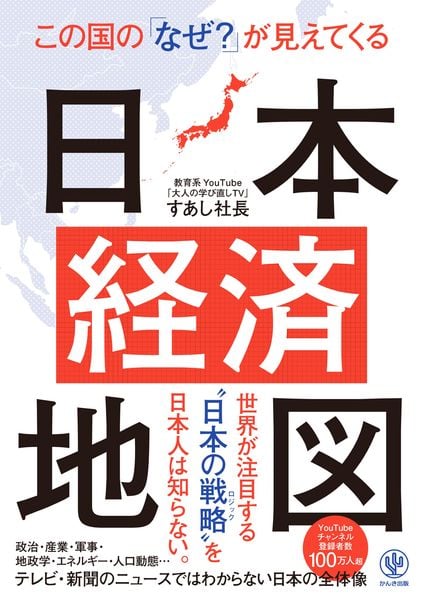
・The cost of Japan overtrusting the autonomous recovery of the market against the appreciation of the yen and putting off the essential issue of “transformation of the industrial structure” has bounced back in the form of widening inequality and a decline in growth potential. Specifically, as the main battleground of the global economy shifts from “hardware” to “IT software” represented by GAFAM, Japan stuck to “manufacturing,” which is a successful experience in the past. As a result, semiconductors, which once held 50% of the global market share, and home appliances that took the world by storm were robbed of the market by overseas players such as Samsung and apps that rode the wave of digitalization (p30)
・Silicon Valley developed around Stanford University, which uses the defense budget as a receptacle, and military networks nurtured here were converted to the “internet,” and missile guidance technology was transferred to the private sector to “GPS.” · Huge businesses such as Google Maps and Uber were born. If you trace the origin of Google's search engine development and iPhone speech recognition, they also originated from this national investment, and were practically supported by American taxes (p36)
・In normal capitalism, companies raise funds at their own risk and are eliminated from the market if they fail, but in Chinese state capitalism, funds that can be said to be inexhaustible are injected into industries strategically determined by the country through government-affiliated financial institutions. Since huge investments that disregard profitability are carried out based on the criteria of whether profits will be made but whether they are necessary for dispatching a nation, Western countries that fight with individual private companies were unable to compete in terms of scale and speed (p34)
・High municipal administration, which was overtaken by India in 2026 nominal GDP and became 5th in the world, activated “Sasaenomics 2.0,” and its true form is a major shift to “aggressive finance,” where the country abandons austerity measures that have continued for many years and makes huge investments. The government directly poured money into fields for the country to survive, and it was decided to promote growth that could not be left to the private sector at the initiative of the nation. As a result, the Nikkei Average rose to the 50,000 yen range (p39)
・Prices in Japan are abnormally low compared to the rest of the world; as of 2025/7, Japan's Big Mac is 480 yen, in America, 836 yen in yen conversion, and 1337 yen in yen conversion in Switzerland. The Japanese yen is “minus 43.9%” undervalued. In other words, Japan's price level is “almost half the price” of the world standard (p44)
・Japan recorded the largest surplus ever with a current account balance of 17.5 trillion yen in the first half of 2025, but the trade surplus accounts for only about 0.3%, and the rest has changed to a structure that maintains a surplus due to dividends and interest obtained from assets invested overseas in the past (p49)
・Since Japan has huge government bonds, it is difficult to raise interest rates, and most of the government bonds held by the Bank of Japan were purchased in the zero interest rate era in the past, and interest = income obtained from international sources is almost zero, while the Bank of Japan must pay interest according to the policy interest rate on current accounts held by the Bank of Japan in private banks, in other words, even though interest from government bonds is almost zero, the policy interest rate is raised by 1% to private banks A huge amount of interest payments will be accrued (p63)
・Companies have huge internal reserves, but savings are not the essence of the problem, and there is a problem where the Japanese market is unable to present “future security” and “growth expectations” sufficient for companies to make aggressive investments and bold wages. For this reason, regulatory reforms and demand creation are desired to break this vicious cycle (P74)
・Even if the Bank of Japan supplied a large amount of money, it did not lead to corporate capital investment or wage increases, but GPIF, which manages our pension reserves, recorded huge management gains due to stock appreciation, and it is an advantage that the sustainability of pension finances has increased due to this (P82)
・It is important to note that the current Japanese version of stagflation is a historically new type of “mild inflation+ impoverishment amid labor shortage (full employment).” Since they are not unemployed, it is difficult to share a sense of crisis, but they have fallen into a situation that should be called “poor full employment,” which is worse in that standards of living are devalued in terms of change (P106)
・The reason why China is rushing to unify Taiwan is that military rationality exists; the east side of Taiwan = the Pacific side has deep waters several thousand meters deep right from the coast, so Chinese nuclear submarines can target the American mainland from anywhere in the Pacific Ocean without being detected by anyone. Taking Taiwan is the final condition for China to become a nuclear superpower equal to America (P122)
・The hidden strength of the defense industry lies in the core materials that make up it rather than the final product; in particular, there is a structure where the market share of the Japanese materials industry in the aerospace field is overwhelming, and the Western military industry is also forced to depend on the Japanese supply chain, and there is a structure where Western 5th generation aviation forces cannot be established without Japanese material technology (P142)
・What the war in Ukraine clearly showed is that the stage before exercising physical destructive power (land, sea, and air), or the fact that attacks and defenses in the “space/cyber/electromagnetic wave” region developed in parallel with it determine the course of victory or defeat, and it does not function no matter how high performance tanks or escort ships have (P154)
・The Russian military tried to neutralize Starlink with strong electronic warfare, but the SpaceX side took countermeasures at an astonishing speed. Interference was avoided by rewriting the software in just a few days and changing the frequency and modulation method of the signal. The military use of Starlink completely overturns conventional common sense of military satellite communication, and since thousands of small satellites form a mesh network in low orbit, the entire system does not go down even if dozens of aircraft are destroyed and disabled. This decentralized architecture was the strongest defense against physical attacks and electronic attacks. This fact proved that linking many inexpensive small satellites is more “resilient” against attacks than having a small number of expensive large satellites (P156)
・The true strength of the Japanese manufacturing industry is its “undercover power” that cannot be seen by general consumers, and that is the field of “materials/parts/manufacturing equipment” (P206). In the semiconductor supply chain, it holds the “choke points” of “front-process manufacturing equipment” and “post-process parts” at both upstream and downstream ends, which is the real reason why it continues to be an entity that cannot be ignored even from America and China (P210)
・Modern automobiles are also called “running smartphones,” and we are now in an age where in-vehicle software affects competitiveness, the car itself is always connected to the internet, and driver support functions and entertainment functions are updated from time to time. Tesla and Chinese EV manufacturers are leading the way in this world, and full-scale introduction of the Japanese Toyota in-vehicle OS development will begin in 2026 (P226)
・A huge change occurred when Japan was at a standstill with “relearning,” which is “generative AI,” and the explosive spread of generative AI after 2023, which is “generative AI,” brought a decisive “AI gap” to the 2025 labor market, and polarization between “AI strong people” who master AI and increase productivity several times, and “AI weak people” replaced by AI. This gap can never be bridged by conventional efforts or long working hours. We are at a turning point between rejecting technology and turning to the side being eliminated, or whether we completely overuse AI and turn to the “evolving side” (P328)
・The “power to know” and “power to think” that you have learned and acquired will continue to be weapons that protect you and pave the way even in turbulent times. “Keep learning” This is the “single greatest survival strategy” for an uncertain future. I believe that the accumulation of “small changes” of each person, where we “learn” and “act” without fear of change, will eventually drastically change the future of this country (P350)