
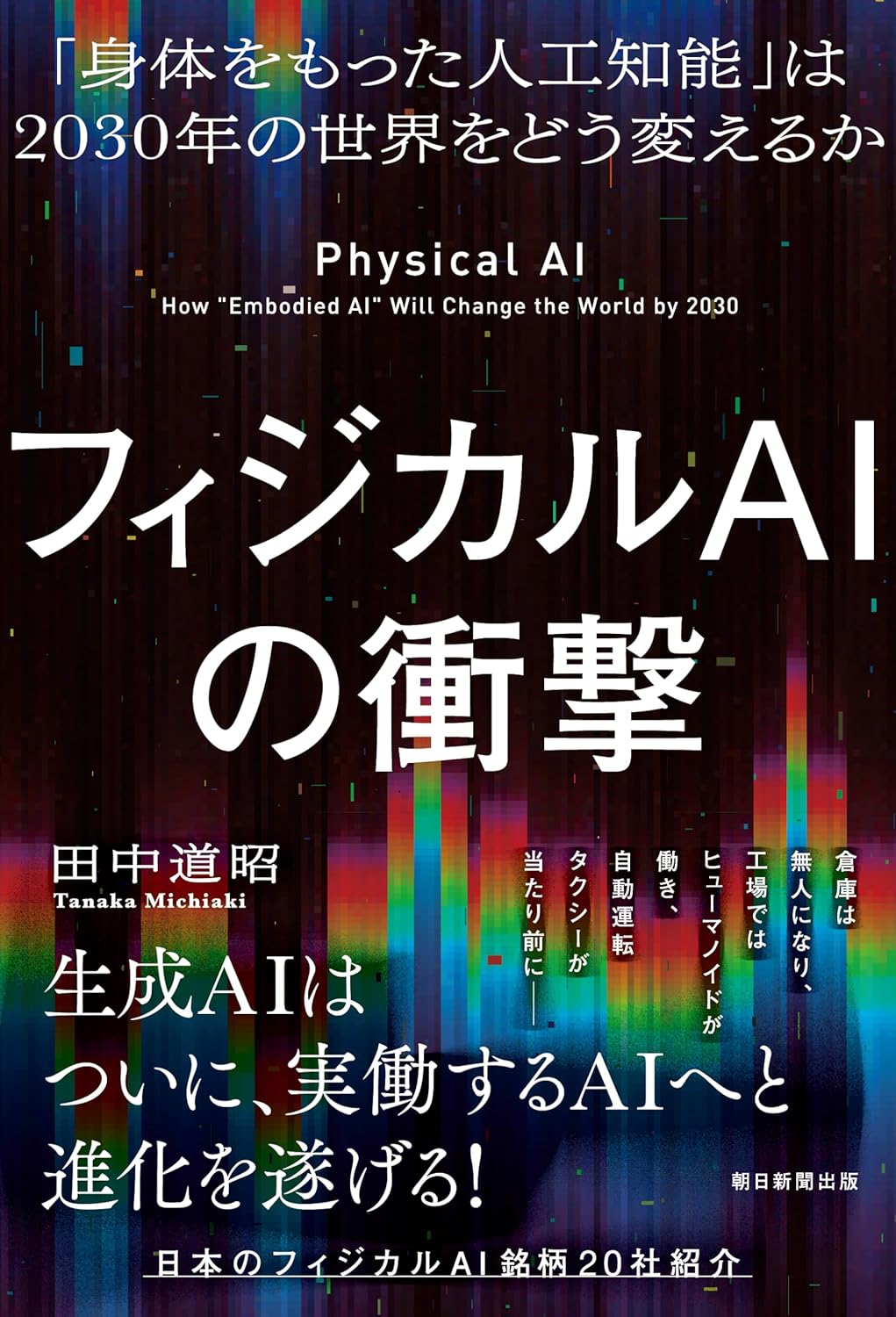
This book discusses the essence of “physical AI” and its social and industrial impact as a major technological innovation that will arrive after generative AI. The author defines physical AI as “artificial intelligence with a body” that recognizes the real world with sensors, makes judgments with artificial intelligence, and works on the real world through a driving device (P3).
Conventional AI has mainly functioned in the information space. Generative AI also handles symbols such as sentences and images, and there is no gravity or friction there. However, physical AI targets the real world itself. Self-driving cars are a symbol of this, and they run on the road with people on them, and if judgment is wrong, the result is an accident immediately. What is important is not that AI is perfect, and even though it is imperfect, it has begun to be operated as part of the real world (P5). Here, there is a qualitative shift from intelligence that processes information to intelligence that acts and takes responsibility in the physical world (P32).
The author points out that while generative AI changed white-collar work, physical AI rewrites the site itself. Areas such as process control, quality control, and equipment maintenance, which until now relied on the experience and intuition of skilled people, will be reconstructed using sensors and AI (P7). As a result, what is first affected is the privilege of site managers and skilled technicians, and the difference between companies that can redesign organizations based on physical AI and companies that introduce it as a simple tool becomes decisive (P7).
However, the author does not see the role of AI as a replacement for humans. The essence of AI is not to make people unnecessary, but to create space where people can concentrate on work that only humans can do (P22). The essence of physical AI is to transform every site, such as a factory, warehouse, store, medical care, nursing, home, etc. into a “place that continues to learn and improve” (P24).
Autonomous driving was the starting point. According to the author, autonomous driving was chosen because it was the most difficult issue, and at the same time, the most valuable issue (P29). The social significance of reducing 1.2 million deaths per year due to traffic accidents, the environment where diverse and huge amounts of data can be acquired, and the possibility of application to other fields have made autonomous driving a leader in physical AI (P29). Autonomous driving was the first entity to simultaneously demand three conditions from AI: physical laws, judgment without correct answers, and ethics where failure is not allowed (P32-33).
Conventional automation equipment works as designed by humans. However, physical AI learns data obtained from the field and continues to search for improvement methods by itself (P37). What is important is not the introduction of technology itself, but the cycle of “events that occurred at the site are stored as data, learned, and the results are returned back to the site” continues to circulate (P52). When this cycle begins, the site is not just a work place, but changes to a “learning site” (P52).
The author states that the source of competitive advantage also lies here. Field knowledge is a learning asset accumulated over time of repeated failures and improvements, and cannot be purchased from outside (P54). Generative AI was able to catch up to a certain level if the same model was used, but in physical AI, the learning target is each site itself, so the difference widens over time (P54). Therefore, what divides the fate of companies in 2030 is not scale or name recognition, but whether they have a “site that continues to learn” (P55).
As physical AI progresses, the role of humans will also change. AI will be responsible for routine tasks and decisions, but humans remain responsible for deciding “which decisions to entrust to AI” and “whether the direction of improvement is correct” (P59). What is being asked is not whether or not AI has been introduced, but whether it is possible to maintain a site that continues to learn (P59).
The unit of competition is also changing in the manufacturing industry. Until now, it has been competition between products, but in the physical AI era, it will shift to competition among factories themselves (P106). The differentiating factor is not product performance, but rather changes to production speed, flexibility, and operation rate (P116). Physical AI is not a technology that eliminates failure; it is a mechanism that transforms failure into learning (P117).
Furthermore, the author predicts that humanoids will penetrate society for 2030 (P49). The reason it is a humanoid is that the infrastructure of human society can be used as it is, and it also functions as a physical platform integrating multiple specialized AIs (P49). Humanoids become “third flatmates” that are neither family members nor home appliances, and they become beings that create time for people (P196).
Regarding international competition, differences between China, the United States, and Japan are depicted. China takes a strategy of mass-producing “bodies” first and learning from the field against the backdrop of mass production technology cultivated with drones and electric vehicles (P273). The United States will refine the model first and adopt a strategy to increase the degree of perfection in virtual spaces (P277). Meanwhile, Japan has the potential to build a third path integrating the body, AI, and data sovereignty (P279). However, if the body and OS cannot be integrated by the early 2030s, there is a risk that they will remain in implementation countries subordinate to foreign-made algorithms (P271).
This book positions physical AI not simply as robot technology, but as a “structural transformation that changes the field into an entity that learns.” Furthermore, it has been concluded that what determines competitiveness in 2030 is not the introduction of AI itself, but whether or not it is possible to have a “site that continues to learn” (P55). This means that not only companies, but society as a whole will change the principles of competition.
summary
The impact of physical AI How “artificial intelligence with a body” will change the world in 2030

 How a small company makes a big comeback with “AI employees” The reality of a site where AI agents do the work for 10 people
Katsuhiko Sato
How a small company makes a big comeback with “AI employees” The reality of a site where AI agents do the work for 10 people
Katsuhiko Sato
 Preparing for a future where everything will accelerate in 2030 investment law the future seen from the perspective of money
Yasushi Katabami
Preparing for a future where everything will accelerate in 2030 investment law the future seen from the perspective of money
Yasushi Katabami
 メタスキル 努力の価値が変わる時代の「AI×自分」戦略
深津貴之 尾原和啓 けんすう
メタスキル 努力の価値が変わる時代の「AI×自分」戦略
深津貴之 尾原和啓 けんすう
 AIの時代に頭がよくなる人 悪くなる人
岡 瑞起
AIの時代に頭がよくなる人 悪くなる人
岡 瑞起