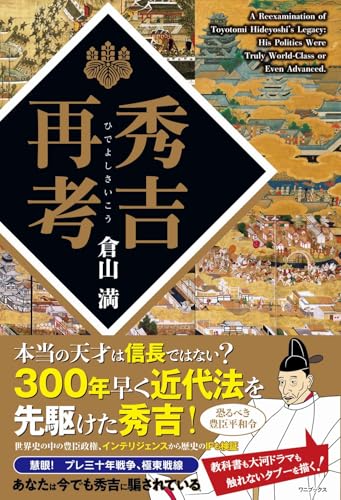
・There was an image that Nobunaga was a genius, but in recent research, it is said that Nobunaga was not a revolutionary person, but rather a “retro person.” Nobunaga was a medieval man, not an early-modern man, that is, he was not a genius who created something out of nothing; rather, he was a man of effort and ingenuity. Extraordinary results were achieved due to the accumulation of efforts that even ordinary people can do (p9)
・The reasons why neither the Portuguese nor the Spanish were able to colonize Japan were 1) they had a strong sense of crisis because the Japanese were smart, 2) they were economic and resource powerhouses, and they were also agricultural powers, and 3) they had strong military power (p23)
・The episode of “Sunomata Ichiya Castle” by Hideyoshi is famous, but it is also important to notice the castle quickly, but it was more important (indirect invasion) to cultivate the local lords so that they would not be attacked by opponents during construction (p29)
・Since Hideyoshi was in the Sengoku period, he was effective; if he had no ability, he declined, but if he didn't have a family, people didn't move; the Sengoku period was an era that dragged on the Muromachi authoritarianism where no one was replaced by the Ashikaga Shogun family even if it was established only in rural areas (p38)
・Orders have no purpose or discretion; they simply do what they are told, and the issuer is responsible. The issuing side must give detailed instructions. In an order, the issuer indicates the purpose and limits the means, and the recipient has discretion according to the given conditions. The issuer only indicates the purpose of the instruction, and discretion (authority) is granted to the recipient. In the Three Eikaku in the Sengoku period, Nobunaga is said to be the person who gave the command, Hideyoshi gave the order, and Ieyasu was the one who gave the instructions (p47)
・Nobunaga is not amazing because he doesn't fail, his judgment and actions after failure are amazing (p56)
・The burning of Hieizan Enryaku-ji Temple by Nobunaga is legal in light of modern international law. This is because Hieizan Enryaku-ji Temple is a temple, so it should be a neutral zone; neutrality has an obligation not to be complicit in public electors on one side, and Enryaku-ji Temple, which has an obligation of neutrality, must not include both public electors in Enryaku-ji Temple. However, Enryaku-ji stationed soldiers from Asakura and Asai, and Nobunaga advised Enryaku-ji to withdraw troops over 3 times, and even warned non-combatants to escape, but they refused (p62)
・Attacking military provisions is not a no-risk battle for the attackers either; if any point is broken through the encirclement network, everything will collapse (p115)
・Both Oda Nobunaga and Toyotomi Hideyoshi took over the country with their ability, but they perished when they lost their ability. Tokugawa continued, but I don't know what would have happened if the war continued. The characteristic of Japan is that the strongest person does not become the greatest person. When the strength of the strong person declines, a dispute occurs and the strongest person is decided, the world is recognized by the greatest person (emperor) and the world stabilizes (p161)
・Hideyoshi and the “Toyotomi shogunate” might have been possible after the attack on Odawara, but since they were already in a much higher position at that time, there was no need to become shogun. Minamoto Yoritomo and Ashikaga Takauji also controlled Kanto when they became Seii Taishogun, and so did Tokugawa Ieyasu later (p165)
・If the definition of Tenkajin is defined as “the person in power who controlled Kyoto,” Hosokawa, Ouchi, Miyoshi, Yanagimoto, Matsunaga, Oda, and Hashiba were there before the Battle of Komaki and Nagakute (p172)
・Piracy became an enemy of humanity from the 1856 Treaty of Paris, which was a peace treaty in the Crimean War where England and France helped the Ottoman Turks and fought against Russia, and pirates were banned for the first time at this time, and terrorists were treated the same way thereafter (p183)
・In Japan, during the Toyotomi Hideyoshi era, “Soru Incident Case,” “Piracy Suspension Order,” and “sword hunting” were carried out in the name of the emperor (p185)
・The concubine is an official wife, has appropriate property rights, and is not a mistress. One Night Wife (Not Even Her Lover) (p191)
・European countries were unable to beat the Ottoman Turks even if they fought with allied forces, and even after (the Battle of Lepanto (1571), which Spain is said to have won, the Ottoman Turks held control of the Mediterranean Sea. Therefore, Spain headed to the American continent and Portugal headed to the African continent, and came to Japan while conquering weak countries (p220)
・Nobunaga is thought to suppress religion by burning down Mt. Hiei, etc., but sects that follow power and do not cause trouble to other religions are protected. The temple was burnt down, but not a single shrine was burnt down (p223)