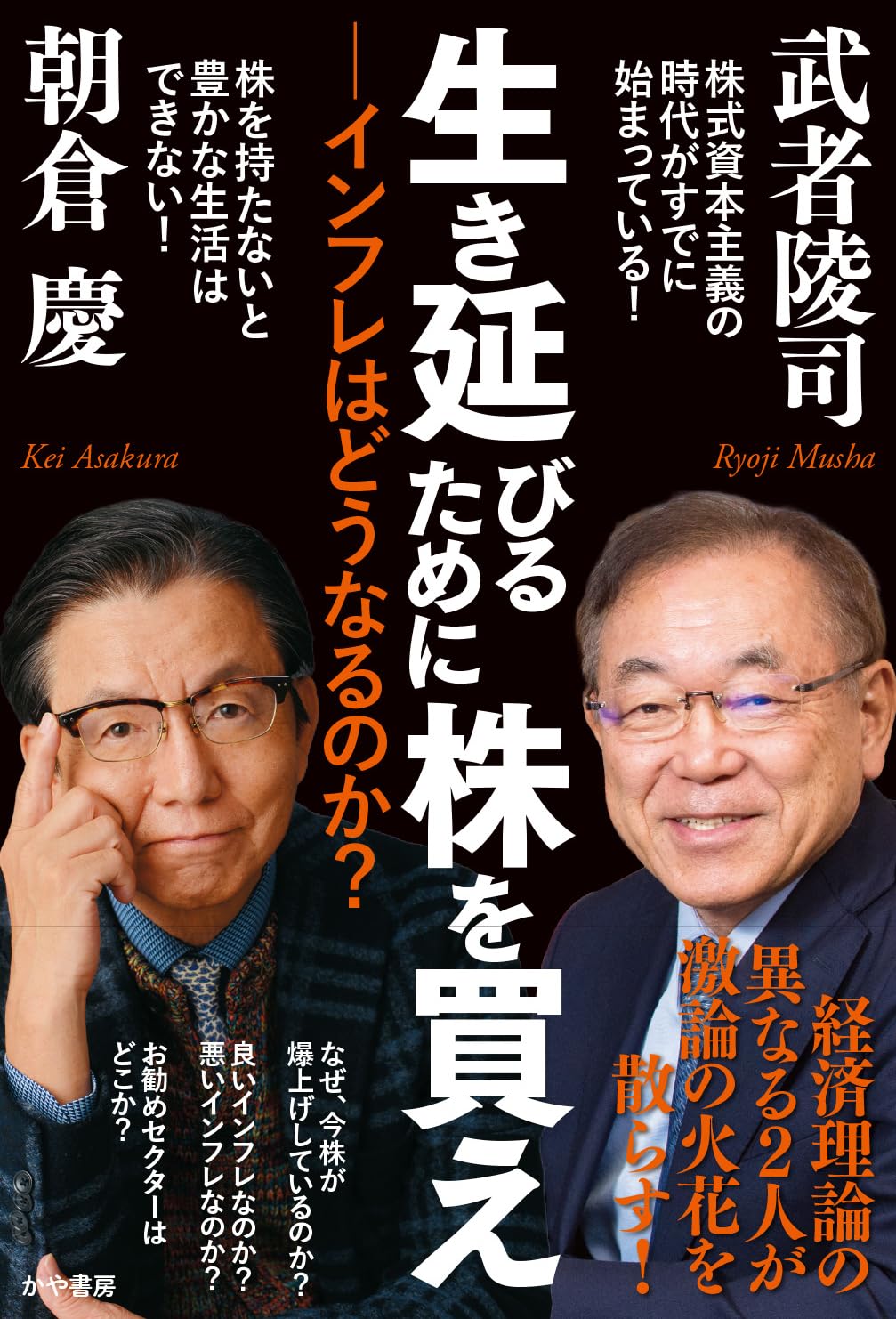
Recently, I also read a book by Mr. Asakura, who is one of the co-authors of this book, and I found it on the internet and became interested. When I looked up the records, I had read 2 books by the other side, Mr. Musha in the past.
The two have in common the fact that they “hold Japanese stocks (I understood it as an index fund)” as future asset management, but there are differences in the analysis of the Japanese economy leading up to that point and the current state of policies and tax systems.
This book is a dialogue book, but the commonalities and differences between the two people's issues were summarized at key points, and my mind was sorted out while reading it. Buying “stocks” is recommended rather than gold, so I thought I'd consider it a little bit too.
Below are the points I was concerned about.
・Views of both Mr. Asakura and Mr. Musha: If inflation subsides, there is no problem with going as before, but if inflation becomes established, the difference between those who have stocks and those who don't, and those who can protect assets will quietly, but surely, and explosively widen. The world has already begun moving in that direction. I hope this book will be a book that gives readers “judgment materials” rather than a book that gives correct answers (p4)
・Mr Musha's opinion: The meaning of resona nationalization was clear; until now, the government has continued to sacrifice corporate value for bad debt processing, but resona nationalization was different, shareholders' rights were protected, and this policy change was the decisive moment that made Mr. Musha display bullish (p12)
・Mr. Musha's opinion: The real culprit of the double bottom after the burst of the bubble was the deflationary policies of the Ministry of Finance and the Bank of Japan, where the super-strong yen destroyed corporate competitiveness, and this is the reason why Japan suffered the greatest damage even though it was a crisis in other countries (p17)
・Asakura's opinion: The scale of the Lehman shock was an order of magnitude different; the collapse of 1929 and 1990 was only about stocks and land, but the collapse of the Lehman shock was about to occur on an unimaginable scale with derivatives 10 times below the surface, 6 kyoyen (p27)
・Mr. Asakura's opinion: After the bubble burst in 1990, Japan initially only tightened finance, then made public investments that rose to 100 trillion yen, and then put 100 trillion yen of money into financial institutions; however, during the Lehman shock, 500 trillion yen of money was put in 1 year (p31)
・Mr. Musha's opinion: The reality of the Lehman shock was that when asset prices fell and banks rushed to collect rather than lend money during difficult times, a vicious cycle was born where sales lead to further sales (p38) ・Central banks directly buy assets, this policy shift was the essence of “quantitative easing,” and the central bank intervenes in the market as the last lender in response to crises that cannot be handled by conventional interest rate policies, and this was a new financial regime ( p41)
・Asakura's opinion: The only reason stocks are rising now is that they have lowered transit value and are getting better like a feigned illusion (p48)
・Mr. Musha's opinion: America has entered a new growth pattern; equity capitalism (asset income) and government income reallocation (transfer income) are supporting consumption by compensating for sluggish wage growth (p63)
・Musha-san's opinion: Asakura's view, which structurally analyzes the increase in supply capacity and the AI revolution and explains the inevitability of rising stock prices: Critically view the current rise in stock prices as financial inflation (p73)
・Asakura's opinion: Stock price 7 times GDP less than 2 times, this difference simply means inflation has occurred, nominal stock price increases without real economic growth, this is the true cause of bad inflation (p96)
・Concurring opinions between Mr. Asakura and Mr. Musha: The cause of inflation from 2022 onwards is supply chain interruption due to the Ukraine war, and the recognition that the statistical inflation rate is lower than actual lifestyle is also consistent, and as a difference, Mr. Musha's opinion: since supply-side issues are central, inflation will eventually subside in the same way as supply chain normalization, Mr. Asakura's opinion: The depreciation of the yen is a loss of currency value, a structural issue ( p101)
・Musha-san's opinion: 4 reasons why wages did not rise in Japan, pressure to reduce wages due to appreciation of yen, absorption of losses from the burst of the bubble by suppressing wages, shortening hours due to strengthened labor regulations, deflation, and a pessimistic view on declining birthrate and aging population (p103)
・Asakura's opinion: Stock prices are no longer a “mirror” of the economy, and stock prices have become the economy itself. Stock price crash became synonymous with national crisis (p115)
・Mr. Asakura's opinion: It took 34 years from the collapse of the bubble in Japan until stock prices took a high price, but the time of the Lehman shock was 5 years. This is because the fund supply was so successful (p116)
・Mr Musha's opinion: The reason why asset value has become important, the banking system has stopped functioning (credit creation has become impossible due to bad loans) ・Companies no longer need to borrow money from banks (issuing bonds directly through finance) ・Demand creation channels have shifted from bank loans to “asset price increases” (p126)
・Regarding the period of the Nikkei Average of 100,000 yen, Mr. Musha's opinion: within 10 years, and Mr. Asakura's opinion: within 3 years (p139)
・Mr. Asakura's opinion: In the employment DI survey, “minus 38” in all industries is “minus 46,” the non-manufacturing industry is a figure that overwhelmingly lacks people, and if demand stimulus measures are added to that, prices will rise further (p156)
・Mr Musha's opinion: The real cause of the deterioration in life is the “tax increase,” and the national burden ratio rose from 38% in 2012 to 48% in 2022 · The cause of sluggish consumption is not inflation, but excessive consumption of taxes and social insurance. Government finances improved, but household finances were sacrificed accordingly (p163)
・Mr. Asakura's opinion: Whereas inflation itself is a problem, Mr. Musha's opinion: The tax system assumes deflation, where distortion of the tax system is a problem, brought about huge distortions in the inflationary era. While both see the suffering of the same people's lives, the identification of the real culprit is different (p165)
・Mr. Musha's opinion: Japan's price level is a process of returning to a normal price system with wages, prices, stock prices, and real estate that have dropped abnormally from an appropriate figure, and that has dropped too much (p202)
・Views of Mr. Asakura and Mr. Musha: If you look at it on a personal site, the next 10 years will go into a trend where people are buying or not buying stocks, and prices will accelerate in the future, so people who have stocks are good but those who only have cash will be disastrous (p226)
・Views of Mr. Asakura and Mr. Musha: It will take 2 or 3 more years, but if you have money, it's no good, and you have to buy it quickly, and it will eventually go in that direction; in this case, depreciation of the value of money is about to occur all over Japan at a considerable pace, and the high city administration has a policy to further support it (p250)
・Mr. Asakura's opinion: Japan's fatal flaw is that Japan is unable to raise policy interest rates (due to budget deficit and economic countermeasures) ・Policy interest rates are around 0.75% even though the inflation rate is 3% or more, that is, real interest rates are drastically negative · real negative interest rates continue, so the value of the currency continues to be lost ・This is Japan's fate and cannot be stopped (p253)
・Mr Musha's opinion: Investment-led growth will begin, investment to increase supply capacity is necessary due to lack of supply capacity, etc. ・Investment-led economic growth will occur for the first time in the past 30 years ・Construction boom and high-tech investment are investments to increase supply power・Funds that have been made overseas until now will begin to go to domestic investment (p259)