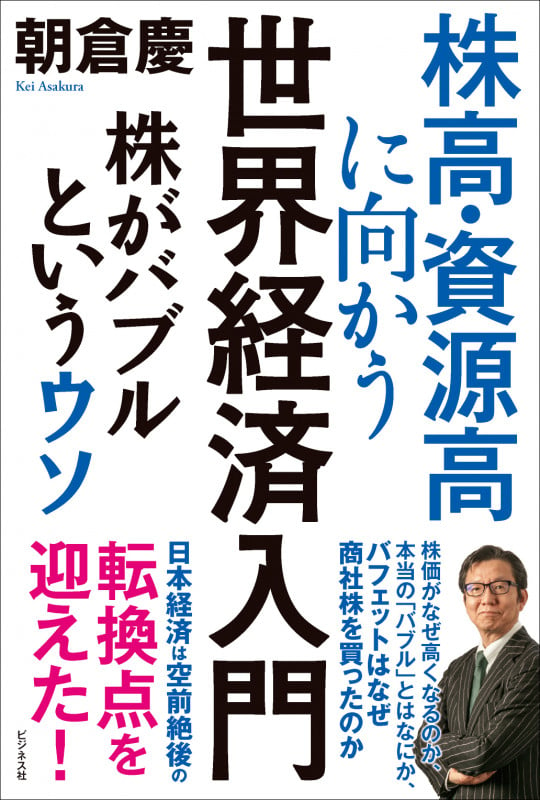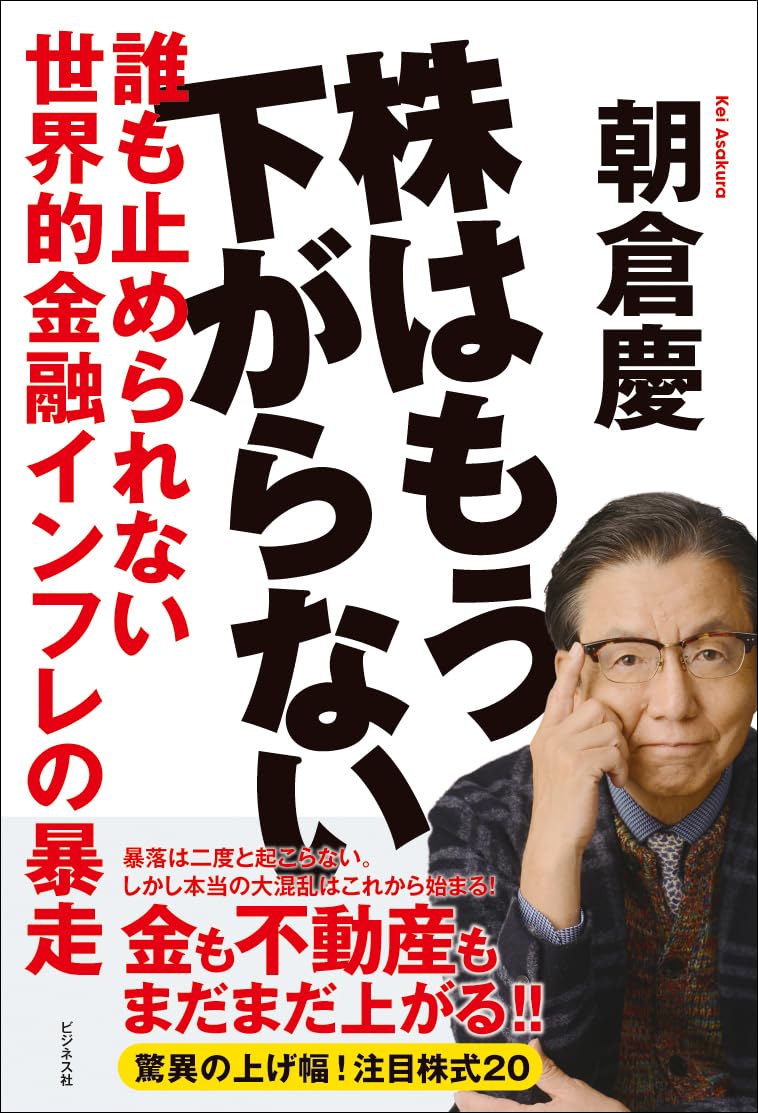
The current stock market is heating up, and I've read a lot of books that say that if US stocks fall, the Japanese market will also crash drastically, so I was surprised when I saw the title of this book at a bookstore, and I bought it because I wanted to know that way of thinking. When I visit bookstores from time to time, I am happy to have this kind of encounter. I was a little relieved because it was written that the gold I'm paying attention to is also in an upward direction.
Prices of not only gold but also silver have increased drastically since around the end of last year (2025), so keep an eye out. It is said that the House of Representatives election will suddenly be held in Japan, and I think the election results will have an impact on the stock market, and I felt that this year is likely to be another year of movement.
Below are the points I was concerned about.
・No matter how much the economy deteriorates in the future, no matter how much chaos the world is, no matter how many wars or financial crises occur, central banks and governments are no longer able to stop “saving” the stock market, stock prices are not the “result” of the economy, but have become the core production target (P2)
・The stock market is no longer a conventional market; stock prices are a policy device that puts the center of policy. This is the true nature of the new capitalism. The biggest side effect created by this system is the structure where the rise cannot be controlled. Stocks are not falling, but now we have entered an era where the rise is unstoppable, the depreciation of the yen is unstoppable, interest rates cannot be stopped, inflation cannot be stopped, and not destroyed by a crash, but by rising. From now on, the world, and Japan in particular, will be hit by unimaginable havoc, and it is important to have real assets in this era (P3)
・Inflation is a system of “secretly taking taxes” from citizens. The tax you secretly take is what I call inflation tax. Regression tax, which is the most cruel “regressive” tax in Japan, is a tax that people with lower incomes are forced to bear more burdens (P13) The wealthy are not inflationary taxes, and they are on the side that benefits from inflation. It is people who have assets who become rather rich due to inflation (P15)
・Politicians like inflation taxes because 1) they don't get caught by the public, and 2) tax revenue increases without permission. When inflation occurs, corporate sales rise, salaries rise nominally, consumption amounts increase, and nominal GDP increases. All of these are directly linked to a natural increase in tax revenue; consumption tax revenue increases without raising the tax rate; 3) the actual burden on government bonds decreases without permission (P19)
・Stock prices are not driven by the economy; the only thing that really drives stock prices is the “amount of money,” and if money increases in the world, that money always flows into somewhere, the stock market has the largest acceptance of stocks, real estate, money, commodities, and crypto assets (P36)
・Inflation = stock appreciation, the 1970s and 1940s in Turkey, Argentina, Brazil, the United States, and Japan (government debt crash, real rise in stock prices) are examples. Inflation destroys currencies, but inflation boosts stock prices. This is a world-wide historical fact (P37)
・The reason why Japanese stocks are entering a historic market is that since it is an inflation+aggressive fiscal period, the three permanent engines that boost stock prices run simultaneously. 1) Nominal sales of companies rise due to inflation, 2) demand for stocks increases due to an increase in the amount of money, 3) export companies explode profits due to depreciation of the yen (p40)
・The fate of Japan becoming an inflationary currency nation has already been determined, and the reason is that 1) finances cannot be stopped, politics cannot stop fiscal expansion, tax revenue increases due to aging, increased defense costs, subsidy dependency society, tax revenue increases due to inflation, 2) labor shortages automatically generate inflation, 3) interest rate increases to protect currency value are minimal, and real interest rates (= consumers from policy interest rates) Prices minus) remain negative, and this is a completely inflationary currency nation, 4) the depreciation of the yen cannot be stopped by the will of the nation, and the reason for this is that real interest rates are forever lower than in Europe and the United States, and this is a consequence of politics and policies chosen by the Bank of Japan. In other words, the depreciation of the yen is the future chosen as policy, 5) what inflationary currency nations arrive at last is an increase in asset value (p46)
・In the future of inflationary currency nations, stock prices will rise · real estate will rise · service prices will skyrocket · food will gradually rise · value of currency will slowly fall · people with cash will suffer · people with assets will become rich. This is not a prediction; it is a “historical result” that inflationary currency nations always follow (p47)
・After 2025, we have entered the third stage of inflation, the first being financial asset inflation and the next, actual inflation, and these have basically created a trend that causes currency values to decline. Then, after 2025, currency confidence began to fluctuate around the world in earnest, and as a result, funds began to escape to places such as stocks, gold, and real estate (p87)
・Until now, the real economy has been good, and wages have risen by looking at it, and financial markets such as the stock market have been supposed to rise as a result, but the current trend has a completely reversed structure from stock market to real economy. The order of finance, stocks, real estate → prices → wages is completely reversed (p91)
・I think interest rates will probably be raised by 0.25% in 2025/12, but it's not possible to make it in time with such an interest rate hike. The negative range of real interest rates is getting deeper and deeper, and if this happens, there is no reason why stocks, real estate, and money cannot be bought. The sharp rise in money is a natural trend that occurred in order to send money. Stock appreciation does not indicate “expectations for high municipal authority,” but it has inevitably occurred as a “result of fund evasion” where “if you have cash, you automatically lose money” (p120)
・There is only one reason why the depreciation of the yen will not stop even if interest rates are raised: the world doubts the value of Japan's currency itself; rapid fiscal expansion · rapid rise in subsidies · rapid rise in minimum wage · worsening labor shortage · lack of structural reforms · 21 trillion yen comprehensive economic policy · constant subsidies for electric gas · Bank of Japan's interest rate suppression over many years; these are combined to signal that Japan is unwilling to maintain currency value It's there (p152)
・Policies that fuel demand with subsidies during inflation are policies that should never be carried out in the first place. When supply is lower than demand, what will happen if only demand is increased, of course, prices will rise further (p158)