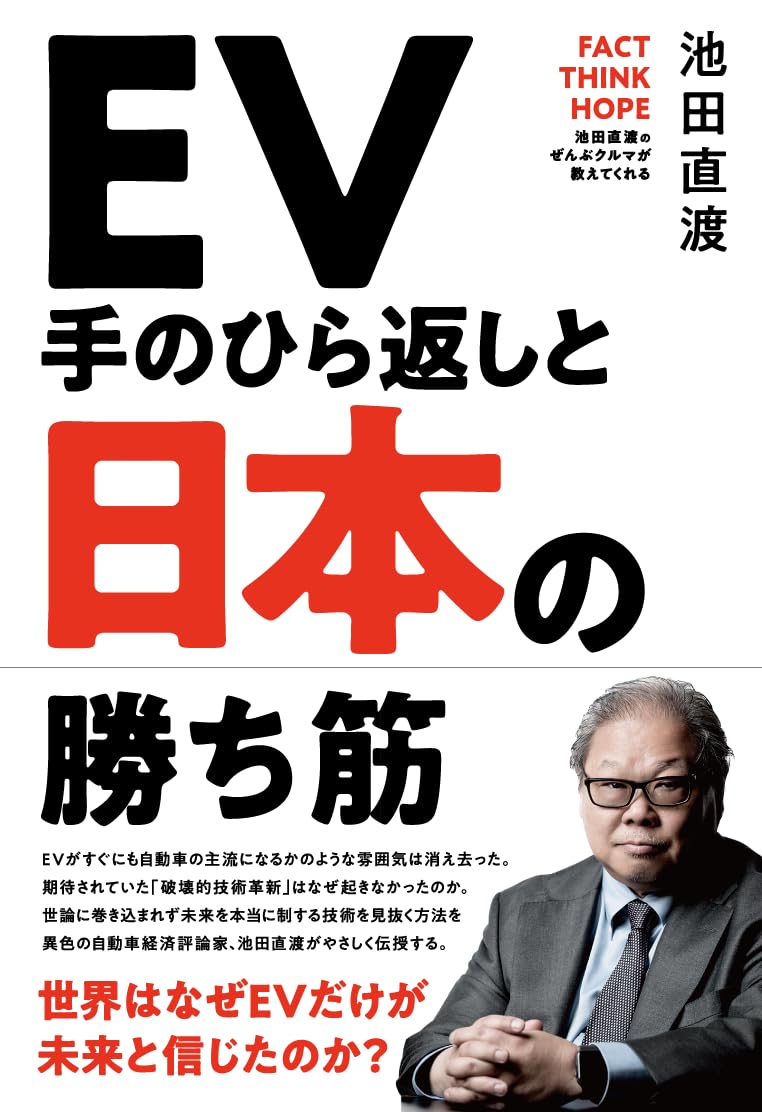
The purpose of this book is not to simply affirm or deny EVs themselves, but to consider ways to see through whether so-called “disruptive technological innovations” will really become mainstream in the future or whether they will end in temporary expectations using EVs as case studies. To that end, the author says that it is important to follow the circumstances of technology, markets, and systems from the past to the present in chronological order rather than looking at new technology as something that has suddenly appeared. It is said that innovations such as the iPhone have a large aspect of combining known technology in a new form rather than the fact that completely unknown technology was suddenly born. (p7 to 9)
The author is careful about understanding EVs with a simple metaphor such as “smartphones destroyed mobile phones all at once.” In reality, it took a long time to develop communication infrastructure for the spread of smartphones. Similarly, EVs do not spread with vehicle technology alone, and many conditions such as charging infrastructure, battery performance, power peaks, resource development, environmental impact, and recycling must be in place. (p19, p22)
Furthermore, EVs are difficult to spread if users do not have a clear advantage compared to existing cars. The author sees that current EVs do not have sufficient competitiveness against existing cars, at least in terms of initial cost, cruising range, and charging time. Therefore, at the beginning of popularization, it is assumed that needs should be expanded from a limited market where needs are clear, such as those who can charge at home, do not require much long-distance driving due to use in urban centers, and can afford prices. (p28 to 29)
As for the background of rapid progress in EV conversion in Europe, the author emphasizes not only environmental issues, but also circumstances surrounding diesel cars. In Europe, diesel cars were promoted as a trump card for reducing CO₂, but there were NOx and PM issues, and the image of internal combustion engines as a whole deteriorated due to exhaust gas fraud issues. Originally, they wanted to advance to hybrid cars, but since Toyota had strong patents, the author's view is that Europe pushed EVs to the front as the next option. (p69 to 72)
What is important in this book is that the environmental performance of EVs is not judged only by CO₂ emissions during driving. EVs have large CO₂ emissions during the manufacturing stage, especially battery production. Therefore, even if emissions are low during the driving stage, it is necessary to run a considerable distance to fill the difference at the time of manufacture, and the author estimates it to be 100,000 km at least, or about 150,000 km at most. However, if it is used up to that distance, the possibility of battery replacement will also increase, and if manufacturing of replacement batteries is included, the environmental impact will further increase. Therefore, it is argued that EVs cannot simply be called “eco” without evaluating the entire life cycle, including manufacturing, use, battery replacement, and disposal. (p88)
In response to this, the author highly appreciates fuel-efficient hybrid cars and light vehicles that are popular in Japan. The basis of energy efficiency is “being small and light,” and many compact hybrid cars and light vehicles equipped with high-efficiency internal combustion engines have become popular in Japan. As a result, results have also been shown in Japan's CO₂ reduction results over the past 20 years, and the author argues that these are technologies that should rather be spread around the world. (p90)
Also, a major limitation of EVs is the weight of the battery. The energy density of batteries is significantly lower than gasoline, and when trying to load the same amount of energy, they become very heavy. According to the author's calculation, if a battery were to hold energy equivalent to 40L of gasoline, it would theoretically be about 900 kg. Since a large amount of energy is used for driving itself at this weight, in reality, the battery amount must be reduced and the cruising range set short. (p123)
In fact, while there are Tesla models that exceed 2.2 tons, the Nissan LEAF is kept at about 1.5 tons. According to the author, Nissan has reduced battery capacity in order to fit within a realistic vehicle weight. When the vehicle weight becomes 2.2 tons, it may exceed the weight limit for multi-storey parking lots in Japan, which impairs convenience in urban areas. In other words, there is a trade-off where if batteries are increased to increase cruising range, other issues such as vehicle weight, price, and parking suitability will occur. (p116, p123)
There are also issues with charging infrastructure. There is a business problem as to who is responsible for installation and operation costs, and there is a balance with contracted electricity even for home charging. Since large amounts of electricity are used only by EV charging, there is a possibility that the power capacity of the home will be insufficient when used simultaneously with air conditioners, microwave ovens, etc. (p101-102)
Taking the example that ships did not disappear due to the advent of airplanes, the author assumes that internal combustion locomotives do not necessarily completely disappear like mobile phones. Each means of transportation has economic rationality and suitable uses. The view is that there is a high possibility that EVs, internal combustion engines, and hybrids can be used properly according to applications and conditions. (p94)
Furthermore, it raises questions about evaluating Norway as an “environmental honor student” by looking only at the spread of EVs. While the country covers most of its domestic electricity with hydroelectric power, it also produces large amounts of petroleum and exports it overseas. The author points out that it is necessary to look at the entire energy supply rather than evaluating environmental performance by looking only at a certain part. (p177)
The author's appeal through this book is neither praising nor denying EVs. What is important is not to determine new technologies as “future winners,” and to calmly compare them, including infrastructure, resources, costs, physical laws, usage conditions, environmental load, and even the results of existing technologies. Also, for Japan, the central assertion of this book is that instead of betting on one EV, utilizing the strengths of each technology, including hybrid cars and light vehicles that already have proven results, becomes a “winning ground.”