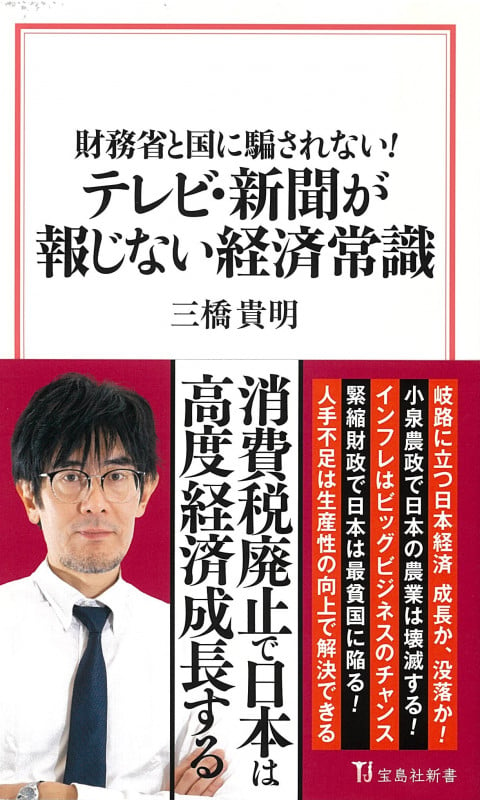
・In reality, there are 10 times more bank deposits than cash notes, and the reason for this is that bank deposits are created simply by “banks lend.” When a reader borrows 30 million yen from a bank, there is absolutely no need for the bank to “procure from somewhere” the 30 million yen to be loaned to the reader, and only records it in the “deposit amount” in the reader's bank passbook (p5)
・Government bonds are not debts; they are currency issued by the Japanese government and are “bonds,” and the Japanese government's debt balance (2015) is 37.4 million times that of 1872 in nominal terms, and 546 times that of 1885 even when price increases are taken into account, and is there a “lender” in the world that allows debt to expand in such a way, national bonds are treasury bonds, currency and bonds issued by the Japanese government, and the banknotes we use in cash are “debts/debts” of the Bank of Japan It's a bank note (p9)
・Financial bankruptcy where government bonds default on debt is a case where “the government issued government bonds in foreign currency and in a common currency” where conditions must be met (p22) Lebanon went into financial bankruptcy due to dollar-denominated government bonds, and it was necessary to borrow dollars because Lebanon adopted a fixed exchange rate of 1 dollar = 1500 Lebanese pounds. In order for a country with a trade deficit to maintain a fixed exchange rate system, it is necessary to issue foreign currency-denominated government bonds and borrow foreign currency from abroad (p25) After the financial collapse in March 2020, a fixed exchange rate system became impossible in Lebanon, and although the official rate is the same, the actual rate is 15,000 Lebanese pounds (p28)
・The process of financial bankruptcy is 1) supply capacity was insufficient and the inflation rate soared, 2) the government adopted a fixed exchange rate against the dollar to control inflation, 3) the government issued foreign currency government bonds to maintain it, and the problem in the first place is not that the country's debt increased due to lack of supply capacity (p31)
・Russia went bankrupt in 1998 because of low crude oil prices; in the case of Argentina in 2001, Brazil, the trade balance deteriorated due to exchange rate increases, and both governments had to withdraw foreign exchange reserves and continue to buy back their own currencies, and as a result, when foreign currency-denominated government bonds became default, it also went into financial bankruptcy even if they built their own currency at the same time (p32) However, it is a country with a floating exchange rate system, and there is no country that has defaulted on national debt denominated in its own currency (p49)
・The reason interest rates on Japanese government bonds are low is that after 2013/3, huge Japanese government bonds exceeding 400 trillion yen were purchased from banks due to the Bank of Japan's quantitative easing policy (p35). The act of banks buying government bonds is an economic act that changes assets called Bank of Japan current accounts without interest rates into government bonds with interest rates (p39)
・The Japanese government dismantles its foreign exchange reserves and continues exchange intervention to buy back Japanese yen in the exchange market, and when the future of foreign exchange reserves can be seen, the Japanese government finally issues dollar-denominated government bonds, and the possibility of bankruptcy is zero (p44)
・In fiscal 2020, the PB (primary balance) deficit rose to the largest extent in history due to COVID-19, but the government bond interest rate was 0%, the PB deficit was just “the amount of money supplied to the private sector in that year,” and the fact that the government had a PB deficit of 56 trillion yen in fiscal year 20 means that the private sector surplus of the same amount is increasing on the other side, and this is a special flat-rate benefit of 100,000 yen per citizen (p54)
・The government's general account tax revenue for fiscal year 20 exceeded the previous fiscal year by 2.4 trillion yen, and the increase in particular was the first consumption tax to surpass income tax (consumption tax: 20, income tax: 20, corporate tax: 10) In 1989, when consumption tax was introduced, corporate/income tax was 20, and consumption tax was about 5 trillion yen (p63)
・When salary income is an annual income of 3.140,000 yen, income tax 6, residence tax 13, social insurance premium 1, take-home payment is 2.47 million years, actual necessary labor costs are 314+47 = 361, and since labor costs are tax-free transactions, purchase amounts cannot be deducted, so 10% consumption tax is added to add 10% consumption tax to 3970,000 yen, and the manager pays employee take-home salary of 2.47 million yen (p69)
・Loan repayment to banks is neither consumption nor investment, in other words, even if money disappears from our hands, it does not become anyone's income, nor does it become bank income (p85)
Read on 2022/7/13