・The structure will change if ethics change, the Meiji government created a centralized nation by abolishing feudal feudal domains and establishing prefectures, adopted a dictatorship system of bureaucrats and military personnel, nurtured industrial industries and zaibatsu by introducing technology and knowledge, and gave authority to farmland landowners, and did this over 10 years (p32)
・Japan's current concept is 1) diplomatic defense belonging to the American faction as a small military power and economic powerhouse, and 2) the economic and social concept of a standardized mass production type industrial society where Tokyo is concentrated unipolar (p34)
・The three things are completely different: a tourist, a temporary worker, and a person who wants to become a citizen of that country (p41)
・If land is donated, the city's property tax revenue will decrease (p54)
・What appears in the national edition of regional stories is limited to the 5 incidents, accidents, elections, sports, and traditional events (p64), and articles originating from the region are rarely taken up in Tokyo newspapers and TV by calling them “inbound stories,” and the exception is “incidents/accidents/elections/traditional events/sports” (p169)
・Learn the local language for everyday conversation (1000) and technical terms (500) necessary for class administration, and finish the rest in Japanese (p101)
・The Edo period also became heaven-oriented due to bureaucracy, and what destroyed it was the “Hell Storm” blown in by the Black Ships. At that time, Europe and America gathered wealth, and the working class faced poverty (p159)
・Japan in the Edo period was a peaceful society with extremely few criminal violence, but only in the fall of Keio 3, a world where people can enjoy it with good luck appeared. It became an ethical change that people at that time could not go back to. This is similar to Ise Oni praying, which has been repeated in cycles of over 60 years since Kanei 15 (1638). (p186)
・Prime Minister Konoe in the 1940s was young, tall, and popular with the public, and against that backdrop, Konoe formed the Taisei Tsubasa Association and rallied political forces to confront the bureaucratic system of bureaucracy and military personnel. However, since the bureaucracy had authority to run through local prefectures, municipalities, and so it was impossible to stand up because it lacked practical functions (p191)
・Compared to fully autonomous driving in Europe and America, Japan has an “guided taxi” system that guides subsequent cars with wireless guidance, and there is an advantage that a taxi driver alone can guide the car of a drunk customer (p244)
・If consumption tax, fuel tax, alcohol and tobacco tax become prefectural taxes, the equivalent amount of government bonds must be taken over by the state (about half), and in order to do so, the state buys all state-owned land or facilities other than those used for national functions, and the market value is like the privatization of JNR in the past rather than book value (p255)
・The role of a country is limited to diplomacy, defense, macroeconomic measures, foreign economic policies such as currency measures, tariffs and trade, etc., national land plans, advanced education certified as national projects, science and technology projects, crime prevention, epidemic prevention, and disaster prevention projects on a national scale (p288)
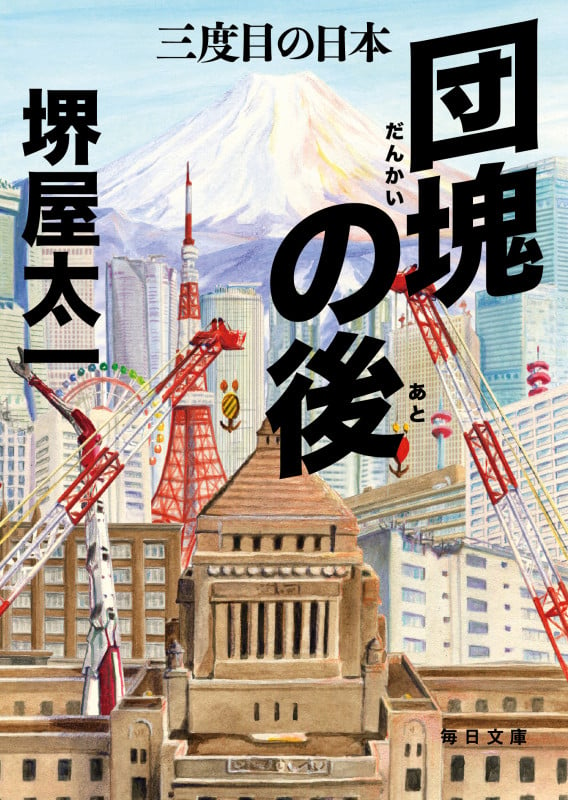
・Meiji Japan aimed to be a strong country, Japan after the second war aimed to be a “rich country,” and the third time Japan wanted to be a “fun country” (p292)
・The current crises in Japan include 1) population decline and aging; 2) a low-desire society with no desires, no dreams, and no motivation; 3) economic contraction with zero growth; 4) huge government debt balances; 5) extinction crises where people don't want to give birth to children (p328)
・Just before the 1941 Pacific War, bureaucrats and military personnel who tried to prevent the start of the war between Japan and the US made an effort, and something called a “Japan-US reconciliation plan” was created between the two sides. The schedule for Alaska's Juneau was decided until the end of August 1941, such as the treatment of Manchukuo, the withdrawal schedule from China, etc., but Minister of Foreign Affairs Matsuoka opposed it, and the Ministry of the Interior agreed, and the meeting disappeared, and the war began (p341)
・3 years to develop a specific concept for the reform plan, 3 years for the movement and training of personnel and staff, 3 years for trial and rework, and 9 years at the earliest (p349) 3 years to think about the outline of a country, 3 years for personnel staff training, 3 years for that rework, a total of 9 years is not too long (p351)