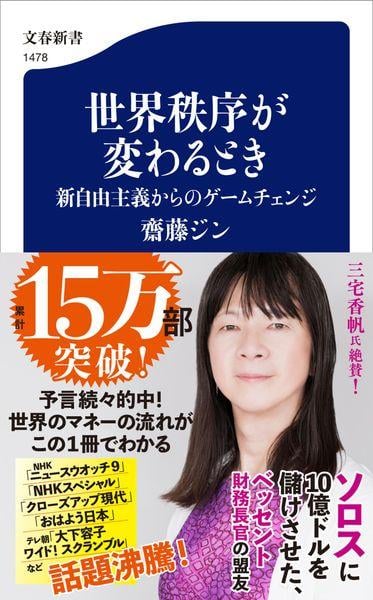
・A neoliberal worldview indicates the values of “small government,” which began as a challenge to the “big government,” which became the dominant worldview of the world system after the 1930s, and came to be accepted as a new world standard system with the collapse of the Soviet Union in 1991 (p6)
・When the existing system changes drastically, the worldview and sense of governance that have supported it also change, and the Taika Reforms in the 7th century fluctuated, leading to a change in the world view centered on the Tang Dynasty ritsuryo system and Confucianism, centered on the emperor, leading to changes in the Kamakura Shogunate and the samurai era, the arrival of Kurofune and the Meiji Restoration, the defeat of the Showa era, and the end of the East-West Cold War at the end of the 20th century are the same. The important point is that new winners and losers are born (p9)
・At this moment, right in front of us, new casino rules are about to be written, which will assume the next 30 years, and at the same time, Japan's society and economy are breaking away from the normal state of deflation called the “lost 30 years,” and Japan has already begun to change (p11)
・The three major elements of neoliberalism are 1) smaller government than large governments, 2) entrusting the role of rulers to the market to replace government and politics, and 3) respecting individual rights and choices, and minimizing interference with the government, religion, and individual way of life (p21)
・While the small government collapsed, it was swayed by a large government, and the pattern was 1) a large government of the communist type, 2) a large government of the Franklin Roosevelt type represented by the New Deal, 3) a large fascist type government in the broad sense that included Japanese militarism, and government intervention in the economy and society began (p25)
・As neoliberalism spreads around the world, money flows efficiently, business costs drop, inflation becomes less likely to occur, prices stabilize, interest rates drop as a result, and time can be set for a long time until investment returns are obtained (p35)
・There has never been an era in human history where economic structures and social values have changed dramatically in such a short period of time; of course, there are people who can't keep up with them, and people they don't want to follow, so distortion will occur (p45)
・There are two main causes of war: 1) exploitation of wealth, and 2) disputes over values such as religious wars; these two are what drive nations to murder; when society is divided by these two, it becomes extremely difficult to deal with them (p51)
・How to come to terms with traditional values and a new way of life, and how to build a balance where both sides can compromise, an important point is to find an equilibrium point where a certain number of citizens, even if not all citizens, feel that they can coexist with others, and establish a worldview that justifies it (p61)
・At a time when the world pursues monetary aggressiveness and is running into a de facto currency devaluation competition, it was clear that if only Japan implemented careful monetary policy management, Japan would lose greatly due to strong yen appreciation and stock depreciation (p111)
・Right now, the world is once again in the midst of a major shift in the view of governance, with America once again being the epicenter of crustal deformation. Like the past two, I think the next few years will be equivalent to a period where historians position “that time was a turning point for Japan” decades from now (p119)
・Two conditions for America to change its attitude: 1) America drastically changes the basic assumptions (worldview, view of governance) of economic policy, 2) competitor GDP approaches 50% of America (p131) Looking at Japan's experience, China already satisfies two standards that draw unrelenting pressure from America, which means there is enough reason to think that we are now at a turning point in history (p134)
・In the case of Japan, instead of everyone accepting a 10% wage cut, it took the form of not getting fired from anyone or raising the unemployment rate, but companies are unable to enter a new growth phase because losses have not been cut; on the other hand, since all employees accept 10% wage cuts every year, output prices continued to fall every year, and as a result, Japan fell into long-term deflation or disinflation, 1999-2022 Until, the bear rate of increase was zero (p140, 202) Japan sacrificed economic efficiency and decided to maintain employment (p144) This means that it can be said that Japanese people chose deflation, or “lost 30 years” (p145)
・Since they cannot earn money in villages where vitality has declined, villagers go to other villages to work, which can be confirmed by the fact that foreign direct investment from Japan has increased markedly since the mid-2000s (p141)
・When an emerging country challenges a hegemonic nation, there are only 3 solutions: 1) the hegemonic country and the emerging country decide victory or defeat in war; as an example, the attack on Pearl Harbor by the Empire of Japan is this pattern, 2) the hegemonic country gave up its place or fell to its knees; as an example, the British Empire went to America after the first battle, and the attitude Japan took America in the 1980s to 1990. Japan took a number of requests for economic weakening, called structural discussions, and made domestic production capacity overseas It was transferred, 3) Cold War, as an example, the US-Soviet Cold War after World War II (p176)
・Once America recognized a country as a country threatening its own hegemony, it would never relax its hands until the opponent was destroyed, the Empire of Japan was a heated war, and the Soviet Union was defeated in the Cold War (p178)
・China's GDP statistics are a bit special, and while other major countries use GDP data based on total expenditure, China creates statistics on a total production basis based on the added value of all economic sectors, and theoretically, the two are the same, but in the case of China, there is a gap in the calculation methods between the two, and it is expanding, and there is a possibility that China's official GDP growth rate in 2010-2016 was overestimated by 1.8 points every year (p183)
・In the event of the Taiwan emergency, it has been suggested that the US Indo-Pacific Force may lose to China, the main reason is that China has deployed too many missiles, so if a military collision actually occurs, there is a high possibility that the US military will not be able to move on the west side of the First Archipelago Line (p186)
・Russia is rich in energy, so it is possible to sell directly or barter transactions with what is needed, so isolation from Russian dollar payments by G7 countries is not that effective, but since China is an energy importer, what China sells to foreign countries is a product, basically dollar payments will increase, and there is no intention of going through capital account liberalization, so let's see when the day when China takes on the challenge of dollar settlement will arrive at all An impassable international settlement ratio of Chinese yuan is 5% or less, and only 2% is held as a foreign exchange reserve (p189)
・Japan's lost 30 years were 30 years of waiting for zombie employees to retire (p195) labor costs were suppressed by making Ice Age students non-regular employment in order to offset the cost of having zombie employees (p200), if wages, which are the biggest input costs, rise, deflation should end (p201)
・America needs a strong Japan, and its degree exceeds that of the Cold War period; when the Soviet Union was the enemy, the stage was Europe, but since the enemy this time is China, the stage is East Asia, and America cannot carry out an effective policy against Asia without a partner called a strong Japan, and that is the same no matter who becomes the president of America (p205)
・In the era of neoliberalism, “just in time” was an ideal supply chain for business owners to procure “what they need, when needed, and as much as needed,” but this business model no longer works, and they are under pressure to build a “just in case” supply chain just in case (p207)
・Japanese companies have resumed both production facility investment and human resource investment domestically, and Japanese companies that were not allowed employment adjustments (kubikiri) tried to survive, transferred production facilities overseas, and continued to suppress domestic human investment, then it is clear that backflow has begun (p208)
・What has mainly worked as an employment maintenance device for zombie employees is that the productivity of the Japanese service industry, which is the service industry for small and medium-sized enterprises, is about America's 6 bets, but conversely, if Japan's service productivity goes up to America's 8 bets, it means that production will increase by 10 points (p214)
・When people cannot be hired due to low wages, it will become an age where companies that can pay wages (for example, AEON) will eliminate companies that cannot pay (for example, inageya), and if only companies that can ultimately secure profits and can pay wages survive, the industry will be optimized, and the salaries of employees working there will also increase every year (p215)
・The Kishida administration made great achievements, made efforts to increase Japan's presence after clearly understanding that the turning point of the world is when new rules are written, has been in Washington for over 30 years, but there is no Japanese prime minister who was welcomed like Prime Minister Kishida, and evaluations of Washington and international financial markets are excellent (p248) Specifically, the Self-Defense Forces have produced results such as doubling defense costs, possessing counterattack capabilities, and rebuilding Japan-US-Korea relations. The speech in Washington about transforming it into an actual army that “fights together” was taken as a strong statement of intent that post-liberal Japan would become America's military partner in the true sense of the word
(p249)