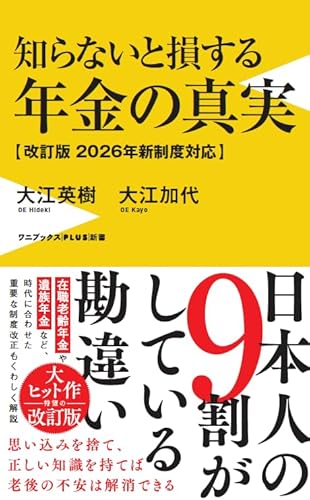
・Although the public pension system itself cannot be said to be perfect, it is sound, and it is true that it has improved while repeatedly reforming and revising the system so far. If you look up facts through training, you can understand that very well (p7)
・Savings and insurance are completely different concepts; savings are “something we save ourselves for future enjoyment,” while insurance is “something we all prepare for future misfortunes” (p33)
・What is important in a pension is not loss or gain, but a sense of security that you can live until what age you live (P38) Having the right to claim goods and services 30 years from now is one of the essentials of a pension (P49) Purchasing power that allows you to obtain things and services of the same value as now no matter how much prices rise (P50)
・From the Showa 30s to the 40s, when current elderly people were active, the weight of private support was still high, and “mutual assistance” through the pension system did not function that much (P69)
・The age to start payment of welfare pensions was 55 years old for both men and women as of 1944, and that was revised in 1954, and at this time, only men raised the period from 55 to 60 years from 1957 to 16, and 16 years after this increase was completed, it was decided that the payment start age for both men and women would be 65 years old in the 1989 revision, but the implementation period has not yet been decided. In 1994, it was decided that the fixed amount portion would finally be implemented from 2001 to 12 years, women would be implemented from 2006 to 12 years, the proportional remuneration part would take 12 years from 2013 due to the 2000 revision, and in the case of women it would take 2018 to 12 years old. In short, raising the recovery start age is not something that can be done in such a short period of time (P76)
・Instead of simply dividing by age and comparing those ratios, we should consider the percentage of people who work support people who don't work. As of 2020, 1 person supports 0.88 people; 30 years ago in 1990, there were 0.96 people per person, and half a century ago in 1970, 1 person was 1.03. Despite the fact that the number of elderly people has increased now since 1970, when it was called a mikoshi type, the number of people supporting them has decreased, albeit slightly. Twenty years from now, 2040 is said to be when the declining birthrate and aging population will peak, and even around that time it is almost the same as it is now (P106)
・When they first started, not only Japan but many countries around the world aimed at the “reserve system,” but they quickly realized that they didn't have it, and all countries changed to the “levy system” at an early stage, and if they operated as a reserve system, that burden would have been enormous (P117)
・What will change drastically with the 2026 revision is survivor welfare pensions received by bereaved families without children in their 20s to 50s. Support will be provided for 5 years during the life drastic change period, but the idea was changed to that no continuous benefits will be provided thereafter (P178) Conventional rules are applied to those who are already 60 years old, those who have accrued the right to receive a survivor's welfare pension before the enforcement date, and those in their 20s to 50s who have children under 18 (P180)
・There is currently an upper limit of 650,000 yen (665,000 yen on a remuneration basis) for the “standard monthly remuneration” used to calculate insurance premiums and benefits for welfare pensions, and 9.6% of men fall under this upper limit table. Therefore, by raising this monthly table to 680,000 yen (2027/9) 710,000 yen (2028/9) 750,000 yen (2029/9), it was decided that respondents would be responsible for insurance premiums corresponding to high wages (P197)
・There is no need for special procedures to delay receipt of a pension; a “pension claim” is sent from the Japan Pension Service 3 months before turning 65, but if you don't do anything here, the payment period is automatically moved forward, so you can complete the procedure when you like (P204)
・In the case of large companies with 1000 or more employees, the average amount of lump-sum retirement allowance for college graduates who have worked for 35 years or more and reached retirement age is 20.37 million yen, 19.09 million yen for high school graduates, and almost 20 million yen for large companies (P219)
・There is a way of thinking of dividing money into 3 ways to use money in old age and dividing money by source for that use, 1) public pensions and corporate pensions for daily living expenses, 2) income obtained by working, working for enjoyment, and 3) medical and nursing facility occupancy expenses are retirement benefits and financial assets (P223)
・When thinking about pensions, keep in mind 5 factors: 1) whether you are salaried or self-employed, and the presence or absence of a welfare pension or corporate pension, which is extremely important; 2) until when you work; 3) whether your company has a corporate pension system; 4) how much financial assets you currently have; and 5) which system you are in a position to use (p238)