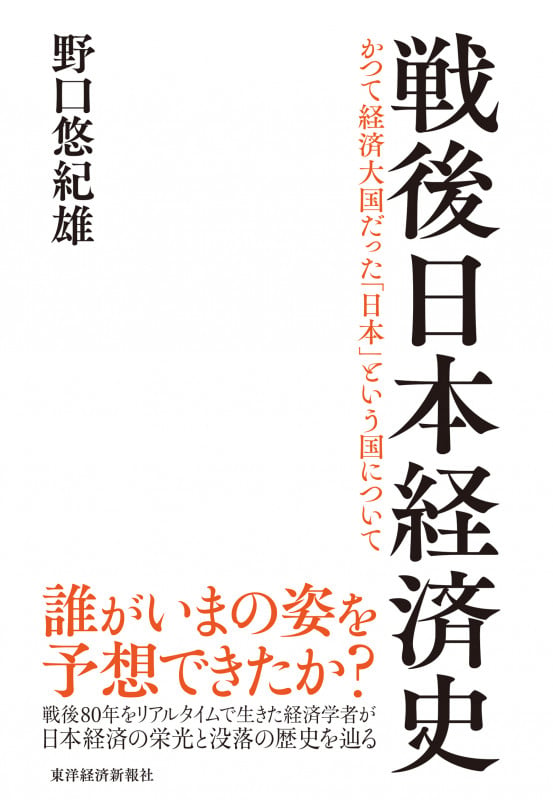
・It is often said that rapid growth was achieved through an economic control system by the Ministry of Trade and Industry, but what actually played an important role was the employment system such as lifelong employment introduced during the war, the tax system centered on direct tax, and the fund control system by the Ministry of Finance and the Bank of Japan. This can be called the 1940 system (p76)
・The major changes that occurred in the 80s and 90s were, firstly, the industrialization of China, and secondly, the IT revolution. Since Japan was unable to respond to these two major changes, the Japanese economy fell into a long period of stagnation. While Japan was rated number one, the world changed like this (p135)
・In response to China's industrialization, the first measure is to differentiate from Chinese products through technology development, business model development, etc. The second policy is to lower prices and compete with Chinese products in terms of price; since Japan took the second measure, it suppressed domestic wages and led to a depreciation of the exchange rate of yen (p152)
・There are multiple reasons why Japan lags behind the IT revolution, but the following points are important: 1) Maintainability of corporate culture. Traditionally, there is a tendency to value long-term employment and internal promotions, and there is a tendency to delay incorporating new ideas and innovative technology from outside. It was a factor that prevented this culture from adopting new technology. 2) Regulations relating to information technology in Japan, which is a regulatory issue, are strict, and the introduction of new business models and services into the market was delayed because of that. In particular, in the telecommunications industry, the country imposed strong regulations, and new entrants and development of innovative services were restricted (p165)
・Japanese manufacturers also made mobile phones, but iPhones were different from those that made it possible to carry conventional landline phones, were different from those, were the same as conventional computers, and had communication functions added to them. In other words, the iPhone was not a portable phone, but a portable computer with phone functions added (p173)
・The appreciation of the yen progressed after the Lehman shock, and since the appreciation of the yen progressed further around 2010, partly due to the influence of the Euro device, calls for a depreciation of the yen spread. When the yen depreciates, corporate profits increase, because sales on a yen basis automatically increase, and price increases in cost are passed on to consumer prices, so Japanese companies that relied on the depreciation of the yen carried out technology development (p204)
・From around 2000, the global horizontal division of labor progressed in America, as seen in Apple, etc., and the manufacturing industry became fabless. This is because such a method became advantageous due to the development of emerging countries and China. In contrast to that, construction of vertically integrated giant structures progressed in Japan, but the operating rate of large structures was sluggish for many years and they were forced to retreat because they were not in line with profitability. After the Lehman shock, unlike the period of rapid growth, it became dependent on government subsidies (p225)
・ The cross-dimensional monetary easing policy from 2013 included problems in several points, 1) targeting the inflation rate, and the state where the inflation rate is high and the unemployment rate is low are simply correlations and do not indicate a causal relationship, in other words, there is no guarantee that the unemployment rate will decline if prices rise (p231), 2) yield curve control began in 2016 from quantitative easing policies, and 2) yield curve control began in 2016 from quantitative easing policies The issuance yield of municipal bonds rose rapidly over, and since these were not subject to purchase (10-year government bonds), interest rates based on market principles were established, in other words, interest rates began to rise where the Bank of Japan did not directly control it. This was a problem with yield curve control (p242) 2022/12/20 The Bank of Japan raised the upper limit of long-term interest rates, that is, yield curve control was stopped (p266) it lifted the negative interest rate policy in 2024/3, and raised it to 0.5% in 2025/1 (p267)
・It is speculated that the true purpose of large-scale monetary easing was to lower market interest rates, depreciate the yen, increase corporate profits, and raise stock prices (p239)
・As a result of the Bank of Japan's purchase of government bonds, the monetary base increased, but money stocks were hardly affected. Since money stock is money, there is a possibility that prices will rise if it increases, but since the monetary base is not something that people can use for settlement, it does not affect prices where it increases (p259)
・There is an opinion that wages are not growing because the number of non-regular workers has increased, but the causal relationship is the opposite, because the total amount of added value has not increased, and since the distribution ratio has not changed drastically, total wage payments have stopped growing. As a result, short-time work in the form of non-regular employees was forced to increase (p278)
・ Nominal wages rose in 2024, but they were not brought about by intrinsic changes or policies in the Japanese economy, but were caused by external factors such as abnormal global inflation (p281) Since consumers have accepted price increases due to inflation in the past few years and price transfer has become easier, nominal wages will rise, but real wages will not be easily stable and positive, and consumers will bear wage increases ( p295) In order to ensure a sustainable rise in wages, improvements in productivity and transformation to an industrial structure with high added value are required, but these are not easy issues, and steady efforts over a long period of time are necessary. However, if this is not done, Japan's decline will accelerate (p298)
・It is assumed that the beneficiaries of social security such as pensions, medical care, nursing care, etc. are all of the population aged 65 and over, and that the expenses necessary for it are borne by the entire population aged 15 to 64. In other words, the burden per working-age person in 2050 will remain the same as in 20 years, and benefits per person for the elderly will be devalued. The source of social security contributions in 2050 will be 0.738 times that of 2020 as the labor force population declines. Therefore, the amount of benefits received per person aged 65 and over is 0.683 times when divided by the rate of increase in the elderly population, in other words, benefits and services under the social security system will be cut by 30% or more (p306)
・Next, consider a “burden adjustment type” where the amount received per elderly person in 2050 remains the same as in 2020. In this case, the amount of social security benefits will be 1.08 times the present due to an increase in the elderly population, and since workers will bear this 0.738 times the current amount, the burden per person will be 1.46 times higher. In other words, it will be necessary to raise the burden by nearly 50% from now. Since such an increase in burden cannot be realized at all, realistically, while benefits are devalued, the burden will also be raised (p307)
・The world competitiveness ranking began in 1989 and from then until 1992, Japan was number 1 in the world, but the effects of China's industrialization and IT revolution became apparent, and it became 5th in 1995, the Japanese manufacturing industry aimed for a vertical integration model contrary to world trends, and the ranking dropped markedly, and the ranking dropped markedly, to 30th place in 2019. According to the rankings published in 2023/6, Japan's international competitiveness ranked 35th out of 64 countries. India and the Philippines are the only ones lower than Japan in Asia, ranking 38th in 2024/6 (p332)
・Looking at GDP per capita, it became the OECD average in 1973 and became twice the OECD average in 1995, then continued to decline and became the OECD average level in 2015, and it continues to fall even now and is around 0.75 in 2023; if it continues as it is, Japan's value will be around 0.5 in 2030, in other words, Japan will be in a state where it cannot be said that it is an advanced country ( p349)
・Japan must stop the downward trend in GDP per capita, but such voices are not raised; on the contrary, there are many people who are unaware that this situation is progressing, and Japanese people's sense of crisis is extremely low. Since prices have begun to rise in the past few years, I think it is becoming possible to break away from deflation, but even if prices rise, people's lives are only getting poorer. Therefore, what should be considered a problem is not prices, but affluence shown in GDP per capita. The problem is that Japan is not growing (p351)