
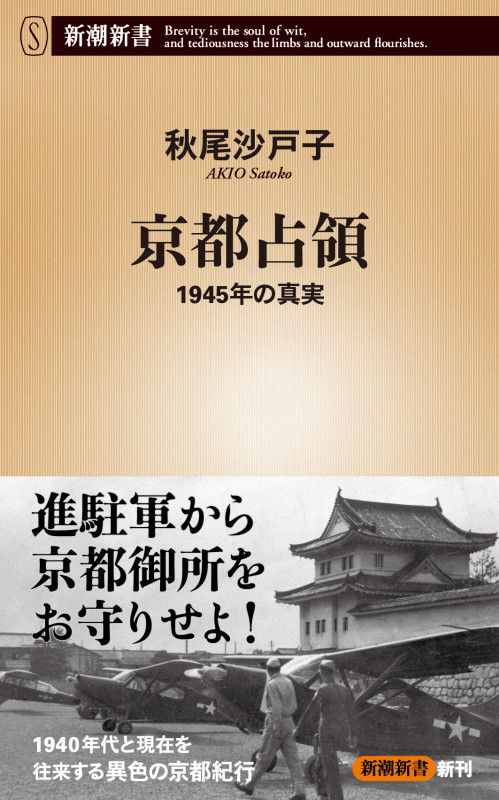
・The atomic bomb candidate sites raised at the first meeting in April 1945 were Tokyo Bay, Kawasaki, Yokohama, Nagoya, Osaka, Kobe, Kyoto, Hiroshima, Kure, Yawata, Kokura, Shimonoseki, Yamaguchi, Kumamoto, Fukuoka, Nagasaki, and Sasebo, and after several meetings, they were narrowed down to 3 or 4 locations. Kyoto was among them, and the reason Kyoto escaped large-scale air raids by B-29 and firebombing was that an undamaged Kyoto is desirable in order to see the effects of the atomic bomb not to protect cultural properties (p13)
・Nagasaki resurfaced after President Truman confirmed that it would be removed from the Kyoto list. The 10th order stating the 4 cities of Hiroshima, Kokura, Nagasaki, and Niigata was issued on 7/25 (p14)
・ The 16th Division was formed in 1905, and a military camp was established in Fushimi. A division is a unit where all soldiers of infantry, cavalry, artillery, engineers, and service heavy forces are gathered, and in short, it is a unit unit capable of fighting (p28)
・Due to the separation of Shinto and Buddhism in the early Meiji period, land owned by Nanzenji Temple and Kiyomizu-dera Temple was taken over by the Meiji government, Gion Kanjinin was quickly transformed from a temple to Yasaka-jinja Shrine due to the abolition of Buddhism, and there was a fear that GHQ might decide the shrine world this time (p39)
・There are many people who misunderstand Heian-jingu Shrine as a shrine that has continued since the Heian period, but in fact, it has an extremely short history and was built after the Meiji Restoration (1895 = Meiji 28), and its newness only heightened the affinity with the US military, and the fact that the grounds and exterior were just as large was received by Americans (p41)
・When His Majesty the Emperor was transferred to Tokyo due to the Meiji Restoration, people quietly disappeared from the city that had flourished for a long time, and just like Nara was abandoned after losing Heijokyo, Kyoto might become the second dance, and one of the town revitalization that impatient Kyoto thought of was the construction of Heian Shrine (p42)
・Although shrines and Shinto were not destroyed, the Shinto Directive was issued from 1945/12/15, and national Shinto will be abolished, but there is no problem with Ujigami as a place of prayer for citizens, and shrines all over the country will remain, but the separation of government and religion must be maintained. In other words, support from the government was cut off, and they had to earn their own money and operate the shrine, and what was born there was a wedding hall (p46)
・Kamigamo Shrine has already been certified as a sanctuary, and other sanctuaries that even occupation soldiers cannot enter unnecessarily include Ise Jingu Shrine, Iwashimizu Hachimangu Shrine in Kyoto, Shimogamo Shrine, and most emperor mausoleums (p90)
・The Konoe family has played an important role in the Imperial Court for generations as the head of the Five Regents, and Konoe is both the former prime minister and the 30th head of the family, and what was on his mind about how the Imperial Family could survive was that if he surrendered, the Allies might pursue responsibility for the emperor, so in the unlikely event of an emergency, they welcomed His Majesty the Emperor to “Ninna-ji Temple” and asked for a decoration, and I thought that if they became a monk, they would escape pursuit by the allied forces ( p108)
・Yoshida Shinto, founded by Yoshida Kaneko (Kanetomo) in the late Muromachi period, received the patronage of the Tokugawa family in the Edo period and created a system like the head of the family with the right to appoint Shinto priests at shrines all over the country, but when the Meiji Restoration established a national Shinto centered around Ise Jingu Shrine, its authority was reduced (p117)
・It was the Navy that asked Kyoto University to develop the atomic bomb, and the Army had already outsourced it to Dr. Nishina of RIKEN in Tokyo. That of Kyoto University, which was secretly requested, was called F Research, and RIKEN Research No. 2. Research requests were also divided between Arakatsu's lab from Kyoto University and Nishina's lab who graduated from the University of Tokyo (p119)
・A cyclotron is a circular accelerator used for basic research in physics, and the one at Kyoto University was the most advanced device in nuclear physics at the time that could cause nuclear fission and make radioactive isotopes. RIKEN had 2 large and small units, and they were also under construction at Kyoto University, and although it was planned to be used to darken uranium in F research, the device was not completed and was not actually used (p119)
・While it is said that the destroyed Cyclotron was dropped off Yokohama in Tokyo Bay and the one from Osaka University was dropped in Osaka Bay, it is still unknown where only the Kyoto University one was sunk (p120)
・The Korean Peninsula was Japanese territory at the time, and the largest munitions factory in Asia was located in Heungnam (Hunnam) in Hamhoon in northern Korea, and the world's largest hydroelectric power plant essential for atomic bomb manufacturing was built by Japanese companies, and it was blessed with resources, and gold, silver, copper, iron, lead, tungsten, coal, magnesium, graphite, mica, yttrium, uranium, etc. were produced in abundance, and any kind of bomb could be made (p124)
・The Soviet Union declared war on Japan on 1945/8/8, and a few hours after the nuclear explosion which is said to have occurred on 8/12, the Soviet Union occupied Heungnam in the northern part of the Korean Peninsula, took away Japanese nuclear engineers, and succeeded in a nuclear test just 4 years later (p125)
・ From 1944/11 to 4/45, balloon bombs were fired at America from 3 locations in Fukushima, Ibaraki, and Chiba; 356 bombs reached the North American continent; the United States had 212, Canada 103, Alaska 38, Mexico 3, and 5 over the Pacific (p140)
・Sugawara Michizane, who was banished to Dazaifu, is enshrined as a tenjin at “Kitano Tenmangu” (p144), the head office of Tenjin in 12,000 locations nationwide (p144)
・On Showa 20/9/24, swords as works of art that military personnel do not carry included not only treasures from shrines and temples, national treasures, but also swords handed down from ancestors, which is the moment when a Japanese sword became a work of art, as recognized by GHQ as being OK to possess (p151)
・President Truman would have agreed to remove Kyoto from the site of the atomic bombing, and from that sense of distance, Japan was moving for peace through the Soviet Union, and from that sense of distance, he may have thought that if America destroyed Kyoto, Japan after the war would become an anti-American nation and approach the Soviet Union, making it difficult for America to take the lead after the war (p189)
・Recently, a different point of view has been explained by American experts; instead of preserving Kyoto, the aim was to attack Nagasaki, which is the base of the nemesis Vatican, and Urakami Cathedral was destroyed rather than the actual military facility Mitsubishi Shipyard (p195)
・I have heard that most of the American soldiers sent to Japan during the occupation were highly educated young people, and most of them were fascinated by Japanese culture and fell in love with a country called Japan (p202)
・The atomic bombing of Japan is unforgivable, but I feel that the accumulation of festivals and people's prayers repelled the implantation of post-war American values in Kyoto, where the national system was maintained by MacArthur and Stimson, and Kyoto remained at one point, and in Kyoto, which continued to be Miyako for over 1000 years, the accumulation of festivals and people's prayers repelled the implantation of post-war American values (p203)