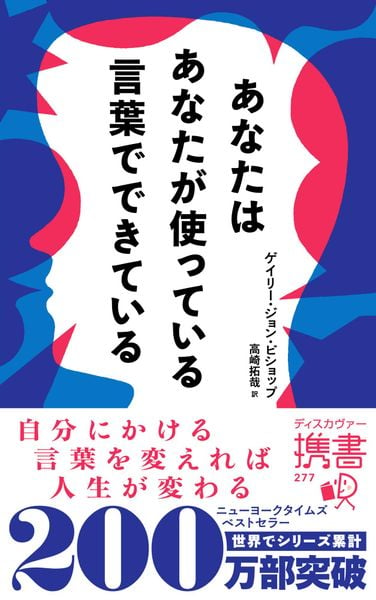
・The way you perceive and feel the situation you are in changes depending on how you express it, and how you spend your life and how you respond to various issues also changes (p15)
・The way you talk affects not only that moment; the way you talk penetrates into that person's unconscious mind, becomes part of the body, and changes later thoughts and actions. In terms of impact on life, the way we talk shapes our outlook on life, and our outlook on life changes our behavior (p20)
・The first step is to stop speaking in ways that don't benefit you and be aware of ways of speaking that are beneficial to you. The way we look at things and relate to the world changes dramatically by using the right words and reframing the problem from a different angle (p25)
・You should use strong assertive words in the present tense of what you are, welcome, accept, and insist on what, and avoid words such as “what do you intend to do” and “what are your goals” (p28)
・If you don't feel like acting to change a situation; if you don't have the will to change the situation in another way, it's the life you chose, no matter how much you don't like it. Situations don't make people; situations are just mirrors reflecting oneself (p34)
・The will to deny has as much power as the intention to do it. Whether the assertion “I'll do it” becomes empowering, or whether declaring “no,” becomes a force depends on the situation (p44)
・If you don't like taking the actions necessary to achieve your goals, it's a sign that you really don't want one. If you acknowledge that, you'll be able to enjoy your current life and be able to work hard for what you really want (p48)
・Dr. Lipton, famous for his stem cells, discovered that 95% of human daily actions are unconscious, which means that conscious actions and actions are only a small part of the whole. What determines the course of your life are those hidden thoughts deep within your heart (p63)
・What is important is to question yourself and reconfirm what actions you have taken; what is the true meaning of those actions? What do you want to prove to be true when you've finished doing or saying it (p66)
・Most of the reasons we can't find a solution is that we're too close to the problem. Let's zoom out a little or a lot to see the whole picture; this is the same technique called the “cognitive reconstruction method,” and it is important to shift the way we look at the problem (p91)
・No matter what kind of decision you make, the best thing is making the right decision, the next best thing is making a “wrong decision,” and the worst is “not making any decisions” (p101)
・Successful people succeeded not because they were convinced of success, but because they didn't stop in situations where they couldn't read ahead. It progressed even though I didn't understand, shook off my anxiety and kept putting my foot forward. I had no choice but to be desperate, so I worked hard desperately (p102)
・If you want to grow, you have to take “good” things that people around you think are stupid and stupid. Life can change completely overnight just by abandoning the idea that how you are viewed is important. Whether influenced by opinions or not, life continues (p108)
・What determines who you are is not what is in your head; what you do is your behavior (p119)
・There are two merits of action: 1) you can do what you need if you act, 2) action is the shortest path to changing thoughts, thoughts become life only through action, and until then they are just thoughts (p125)
・The only way to change your life is to change your behavior; there are many people who had “good thoughts” but couldn't achieve big things, and those are people who only cared about their thoughts rather than actions. Conversely, there are people who have achieved great success even if they have negative thoughts. The point is that positive thinking doesn't necessarily lead to success, nor is negative thinking a one-way path to failure. All great people acted regardless of their feelings (p131)
・The only thing that stops you is accepting someone's opinion to stop. Only then do you really stop. Until then, you're at least somewhat advanced (p140)
・What “you” on your deathbed regret the most is not that you didn't achieve anything or that you didn't get what you wanted. It's “something I didn't try,” it's something I didn't try hard at. It's something I gave up when it got hard (p183)